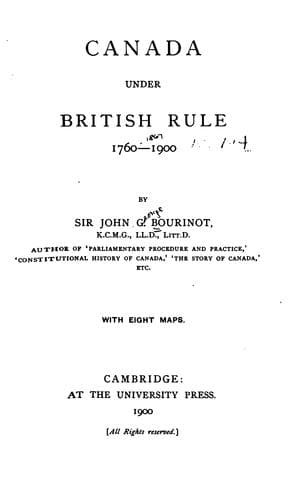
Canada under British Rule 1760-1900Bourinot, John George
History
Canada under British Rule 1760-1900
Bourinot, John George
Canada -- History
statistics clearly showed that the western section exceeded French
Canada both in population and wealth.
A demand was persistently and even fiercely made at times for such a
readjustment of the representation in the assembly as would do full
justice to the more populous and richer province. The French Canadian
leaders resented this demand as an attempt to violate the terms on which
they were brought into the union, and as calculated, and indeed
intended, to place them in a position of inferiority to the people of a
province where such fierce and unjust attacks were systematically made
on their language, religion, and institutions generally. With much
justice they pressed the fact that at the commencement of, and for some
years subsequent to, the union, the French Canadians were numerically in
the majority, and yet had no larger representation in the assembly than
the inhabitants of the upper province, then inferior in population. Mr.
George Brown, who had under his control a powerful newspaper, the
_Globe_, of Toronto, was remarkable for his power of invective and his
tenacity of purpose, and he made persistent and violent attacks upon the
conditions of the union, and upon the French and English Conservatives,
who were not willing to violate a solemn contract.
The difficulties between the Canadian provinces at last became so
intensified by the public opinion created by Mr. Brown in Upper Canada
in favour of representation by population, that good and stable
government was no longer possible on account of the close division of
parties in the legislature. Appeals were made frequently to the people,
and new ministries formed,--in fact, five within two years--but the
sectional difficulties had obviously reached a point where it was not
possible to carry on successfully the administration of public affairs.
On the 14th June, 1864, a committee of the legislative assembly of
Canada, of whom Mr. Brown was chairman, reported that "a strong feeling
was found to exist among the members of the committee in favour of
changes in the direction of a federal system, applied either to Canada
alone or to the whole of the British North American provinces." On the
day when this report was presented, the Conservative government, known
as the Taché-Macdonald ministry, suffered the fate of many previous
governments for years, and it became necessary either to appeal at once
to the people, or find some other practical solution of the political
difficulties which prevented the formation of a stable government. Then
it was that Mr. Brown rose above the level of mere party selfishness,
and assumed the attitude of a statesman, animated by patriotic and noble
impulses which must help us to forget the spirit of sectionalism and
illiberality which so often animated him in his career of heated
partisanship. Negotiations took place between Mr. John A. Macdonald, Mr.
Brown, Mr. Cartier, Mr. Galt, Mr. Morris, Mr. McDougall, Mr. Mowat, and
Public-domain text, read in full here on John Shaqi.
Reviews
Reviews
No reviews yet
Be the first to share your thoughts on this work.
Elsewhere in the archive
Join the Discussion
Join the discussion
Sign in to leave a comment or review.
Sign InorCreate an account