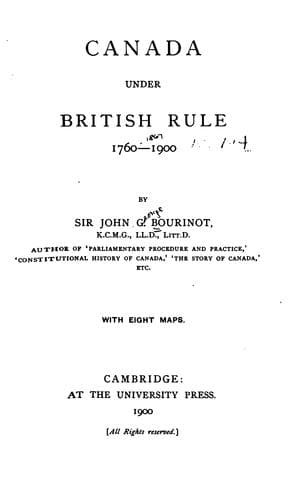
Canada under British Rule 1760-1900Bourinot, John George
History
Canada under British Rule 1760-1900
Bourinot, John George
Canada -- History
In 1671 Sieur St. Lusson took formal possession of the Sault and the
adjacent country in the name of Louis XIV. In 1673 Fort Frontenac was
built at Cataraqui, now Kingston, as a barrier to the aggressive
movements of the Iroquois and an _entrepôt_ for the fur-trade on Lake
Ontario. In the same year Joliet and Marquette solved a part of the
problem which had so long perplexed the explorers of the West. The
trader and priest reached the Mississippi by the way of Green Bay, the
Fox and Wisconsin Rivers. They went down the Mississippi as far as the
Arkansas. Though they were still many hundreds of miles from the mouth
of the river, they grasped the fact that it must reach, not the western
ocean, but the southern gulf first discovered by the Spaniards.
Marquette died not long afterwards, worn out by his labours in the
wilderness, and was buried beneath the little chapel at St. Ignace.
Joliet's name henceforth disappears from the annals of the West.
Réné Robert Cavelier, better known as the Sieur de la Salle, completed
the work commenced by the trader and missionary. In 1666 he obtained a
grant of land at the head of the rapids above Montreal by the side of
that beautiful expanse of the St. Lawrence, still called Lachine, a name
first given in derisive allusion to his hope of finding a short route to
China. In 1679 he saw the Niagara Falls for the first time, and the
earliest sketch is to be found in _La Nouvelle Découverte_ written or
compiled by that garrulous, vain, and often mendacious Recollet Friar,
Louis Hennepin, who accompanied La Salle on this expedition. In the
winter of 1681-82 this famous explorer reached the Mississippi, and for
weeks followed its course through the novel and wondrous scenery of a
southern land. On the 9th of April, 1682, at a point just above the
mouth of the great river, La Salle took formal possession of the
Mississippi valley in the name of Louis XIV, with the same imposing
ceremonies that distinguished the claim asserted by St. Lusson at the
Sault in the lake region. By the irony of fate, La Salle failed to
discover the mouth of the river when he came direct from France to the
Gulf of Mexico in 1685, but landed somewhere on Matagorda Bay on the
Texan coast, where he built a fort for temporary protection. Finding his
position untenable, he decided in 1687 to make an effort to reach the
Illinois country, but when he had been a few days on this perilous
journey he was treacherously murdered by some of his companions near the
southern branch of Trinity River. His body was left to the beasts and
birds of prey. Two of the murderers were themselves killed by their
accomplices, none of whom appear ever to have been brought to justice
for their participation in a crime by which France lost one of the
bravest and ablest men who ever struggled for her dominion in North
America.
Public-domain text, read in full here on John Shaqi.
Reviews
Reviews
No reviews yet
Be the first to share your thoughts on this work.
Join the Discussion
Join the discussion
Sign in to leave a comment or review.
Sign InorCreate an account