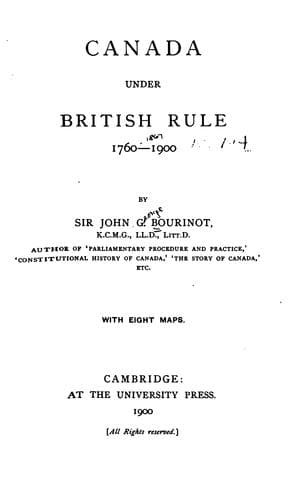
Canada under British Rule 1760-1900Bourinot, John George
History
Canada under British Rule 1760-1900
Bourinot, John George
Canada -- History
On Sir Charles Tapper's defeat at the elections, Mr. Laurier became
first minister of a Liberal administration, in which positions were
given to Sir Oliver Mowat, so long premier of Ontario, to Mr. Blair,
premier of New Brunswick, to Mr. Fielding, premier of Nova Scotia, and
eventually to Mr. Sifton, the astute attorney-general of Manitoba. Sir
Richard Cartwright and Sir Louis Davies--to give the latter the title
conferred on him in the Diamond Jubilee year--both of whom had been in
the foremost rank of the Liberal party for many years, also took office
in the new administration; but Mr. Mills, versed above most Canadian
public men in political and constitutional knowledge, was not brought in
until some time later, when Sir Oliver Mowat, the veteran minister of
justice, was appointed to the lieutenant-governorship of Ontario. A
notable acquisition was Mr. Tarte, who had acquired much influence in
French Canada by his irrepressible energy, and who was placed over the
department of public works.
When the school question came to be discussed in 1897, during the first
session of the new parliament, the premier explained to the house that,
whilst he had always maintained "that the constitution of this country
gave to this parliament and government the right and power to interfere
with the school legislation of Manitoba, it was an extreme right and
reserved power to be exercised only when other means had been
exhausted." Believing then that "it was far better to obtain concessions
by negotiation than by coercion," he had, as soon as he came into
office, communicated with the Manitoba government on the subject, and
had "as a result succeeded in making arrangements which gave the French
Catholics of the province religious teaching in their schools and the
protection of their language," under the conditions set forth in a
statute expressly passed for the purpose by the legislature of
Manitoba[7]. The premier at the same time admitted that "the settlement
was not acceptable to certain dignitaries of the church to which he
belonged"; but subsequently the Pope published an encyclical advising
acceptance of the concessions made to the Manitoba Catholics, while
claiming at the same time that these concessions were inadequate, and
expressing the hope that full satisfaction would be obtained ere long
from the Manitoba government. Since the arrangement of this compromise,
no strenuous or effective effort has been made to revive the question as
an element of political significance in party contests. Even in Manitoba
itself, despite the defeat of the Greenway government, which was
responsible for the Manitoba school act of 1890, and the coming into
office of Mr. Hugh John Macdonald, the son of the great Conservative
leader, there has been no sign of the least intention to depart from the
legislation arranged by Sir Wilfrid Laurier in 1897 as, in his opinion,
the best possible compromise under the difficult conditions surrounding
a most embarrassing question.
Public-domain text, read in full here on John Shaqi.
Reviews
Reviews
No reviews yet
Be the first to share your thoughts on this work.
Elsewhere in the archive
Join the Discussion
Join the discussion
Sign in to leave a comment or review.
Sign InorCreate an account