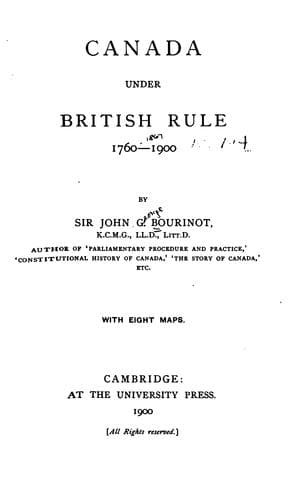
Canada under British Rule 1760-1900Bourinot, John George
History
Canada under British Rule 1760-1900
Bourinot, John George
Canada -- History
[7: This statute provides that religious teaching by a Roman Catholic
priest, or other person duly authorised by him, shall take place at the
close of the hours devoted to secular instruction; that a Roman Catholic
teacher may be employed in every school in towns and cities where the
average attendance of Roman Catholic children is forty or upwards, and
in villages and rural districts where the attendance is twenty-five or
upwards; and that French as well as English shall be taught in any
school where ten pupils speak the French language.]
In the autumn of 1898 Canada bade farewell with many expressions of
regret to Lord and Lady Aberdeen, both of whom had won the affection and
respect of the Canadian people by their earnest efforts to support every
movement that might promote the social, intellectual and moral welfare
of the people. Lord Aberdeen was the seventh governor-general appointed
by the crown to administer public affairs since the union of the
provinces in 1867. Lord Monck, who had the honour of initiating
confederation, was succeeded by Sir John Young, who was afterwards
raised to the peerage as Baron Lisgar--a just recognition of the
admirable discretion and dignity with which he discharged the duties of
his high position. His successor, the Earl of Dufferin, won the
affection of the Canadian people by his grace of demeanour, and his
Irish gift of eloquence, which he used in the spirit of the clever
diplomatist to flatter the people of the country to their heart's
content. The appointment of the Marquess of Lorne, now the Duke of
Argyll, gave to Canada the honour of the presence of a Princess of the
reigning family. He showed tact and discretion in some difficult
political situations that arose during his administration, and succeeded
above all his predecessors in stimulating the study of art, science and
literature within the Dominion. The Marquess of Lansdowne and Lord
Stanley of Preston--both inheritors of historic names, trained in the
great school of English administration--also acquired the confidence and
respect of the Canadian people. On the conclusion of Lord Aberdeen's
term of office in 1898, he was succeeded by the Earl of Minto, who had
been military secretary to the Marquess of Lansdowne, when
governor-general, from the autumn of 1883 until the end of May, 1888,
and had also acted as chief of staff to General Middleton during the
North-west disturbances of 1885.
Public-domain text, read in full here on John Shaqi.
Reviews
Reviews
No reviews yet
Be the first to share your thoughts on this work.
Elsewhere in the archive
Join the Discussion
Join the discussion
Sign in to leave a comment or review.
Sign InorCreate an account