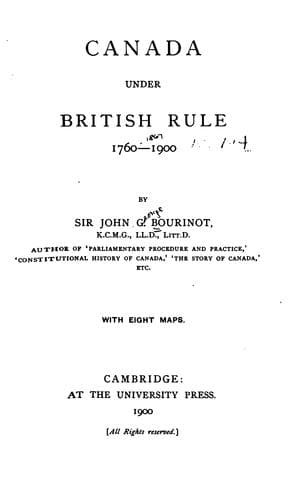
Canada under British Rule 1760-1900Bourinot, John George
History
Canada under British Rule 1760-1900
Bourinot, John George
Canada -- History
The crown exercises a certain supervision over the affairs of the
Dominion through a governor-general, who communicates directly with an
imperial secretary of state; but in every matter directly affecting
Canada--as for instance, in negotiations respecting the fisheries, the
Bering Sea, and other matters considered by several conferences at
Washington--the Canadian government is consulted and its statements are
carefully considered, since they represent the sentiments and interests
of the Canadian people, who, as citizens of the empire, are entitled to
as much weight as if they lived in the British Isles.
In the administration of Canadian affairs the governor-general is
advised by a responsible council representing the majority of the house
of commons. As in England, the Canadian cabinet, or ministry, is
practically a committee of the dominant party in parliament and is
governed by the rules, conventions and usages of parliamentary
government which have grown up gradually in the parent state. Whenever
it is necessary to form a ministry in Canada, its members are summoned
by the governor-general to the privy council of Canada; another
illustration of the desire of the Canadians to imitate the old
institutions of England and copy her time-honoured procedure.
The parliament of Canada consists of the Queen, the senate, and the
house of commons. In the formation of the upper house, three
geographical groups were arranged in the first instance, Ontario,
Quebec, and the maritime provinces, and each group received a
representation of twenty-four members. More recently other provinces
have been admitted into the Dominion without reference to this
arrangement, and now seventy-eight senators altogether may sit in
parliament. The remarkably long tenure of power enjoyed by the
Conservative party--twenty-five years from 1867--enabled it in the
course of time to fill the upper house with a very large numerical
majority of its own friends, and this fact, taken in connection with
certain elements of weakness inherent in a chamber which is not elected
by the people and has none of the ancient privileges or prestige of a
house of lords, long associated with the names of great statesmen and
the memorable events of English history, has created an agitation among
the Liberal party for radical changes in its constitution which would
bring it, in their opinion, more in harmony with the people's
representatives in the popular branch of the general legislature. While
some extremists would abolish the chamber, Sir Wilfrid Launer and other
prominent Liberals recognise its necessity in our parliamentary system.
In all probability death will ere long solve difficulties arising out
of the political composition of the body, if the Liberal party remain in
power.
Public-domain text, read in full here on John Shaqi.
Reviews
Reviews
No reviews yet
Be the first to share your thoughts on this work.
Elsewhere in the archive
Join the Discussion
Join the discussion
Sign in to leave a comment or review.
Sign InorCreate an account