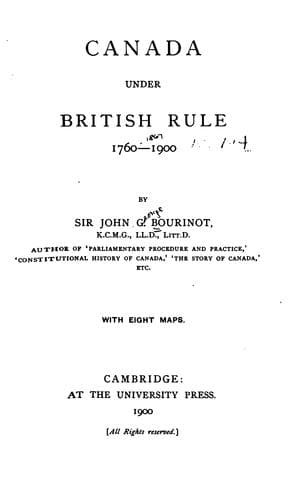
Canada under British Rule 1760-1900Bourinot, John George
History
Canada under British Rule 1760-1900
Bourinot, John George
Canada -- History
The house of commons, the great governing body of the Dominion, has been
made, so far as circumstances will permit, a copy of the English house.
Its members are not required to have a property qualification, and are
elected by the votes of the electors of the several provinces where, in
a majority of cases, universal suffrage, under limitations of
citizenship and residence, prevails.
In each province there is a lieutenant-governor, appointed by the
Dominion government for five years, an executive council, and a
legislature consisting of only one house, except in Nova Scotia and
Quebec where a legislative council appointed by the crown still
continues. The principles of responsible government exist in all the
provinces, and practically in the North-west territory.
In the enumeration of the legislative powers, respectively given to the
Dominion and provincial legislatures, an effort was made to avoid the
conflicts of jurisdiction that have so frequently arisen between the
national and state governments of the United States. In the first place
we have a recapitulation of those general or national powers that
properly belong to the central authority, such as customs and excise
duties, regulation of trade and commerce, militia and defence,
post-office, banking and coinage, railways and public works "for the
general advantage," navigation and shipping, naturalisation and aliens,
fisheries, weights and measures, marriage and divorce, penitentiaries,
criminal law, census and statistics. On the other hand, the provinces
have retained control over municipal institutions, public lands, local
works and undertakings, incorporation of companies with provincial
objects, property and civil rights, administration of justice, and
generally "all matters of a merely local and private nature in the
province." The _residuary_ power rests with the general parliament of
Canada.
The parliament of Canada, in 1875, established a supreme court, or
general court of appeal, for Canada, whose highest function is to decide
questions as to the respective legislative powers of the Dominion and
provincial parliaments, which are referred to it in due process of law
by the subordinate courts of the provinces. The decisions of this court
are already doing much to solve difficulties that impede the successful
operation of the constitution. As a rule cases come before the supreme
court on appeal from the lower courts, but the law regulating its powers
provides that the governor in council may refer any matter to this court
on which a question of constitutional jurisdiction has been raised. But
the supreme court of Canada is not necessarily the court of last resort
of Canada. The people have an inherent right as subjects of the Queen to
appeal to the judicial committee of the privy council of the United
Kingdom.
Public-domain text, read in full here on John Shaqi.
Reviews
Reviews
No reviews yet
Be the first to share your thoughts on this work.
Elsewhere in the archive
Join the Discussion
Join the discussion
Sign in to leave a comment or review.
Sign InorCreate an account