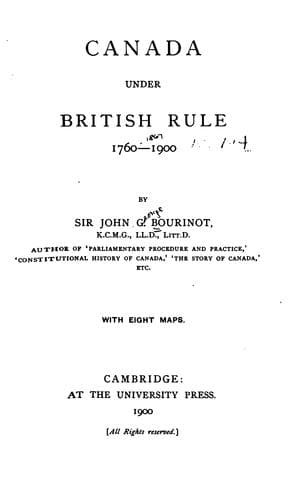
Canada under British Rule 1760-1900Bourinot, John George
History
Canada under British Rule 1760-1900
Bourinot, John George
Canada -- History
In the closing years of French dominion the total population of Quebec,
Montreal and Three Rivers, the only towns in the province, did not
exceed 13,000 souls--about the population of Boston. Quebec alone had
8000 inhabitants, Montreal 4000, and Three Rivers 1000. The architecture
of these places was more remarkable for solidity than elegance or
symmetry of proportions. The churches, religious and educational
establishments, official buildings and residences--notably the
intendant's palace at Quebec--were built of stone. The most pretentious
edifice was the château of St. Louis--the residence of the
governor-general--which was rebuilt by Count de Frontenac within the
limits of the fort of St. Louis, first erected by Champlain on the
historic height always associated with his name. The best buildings in
the towns were generally of one story and constructed of stone. In the
rural parishes, the villages, properly speaking, consisted of a church,
presbytery, school, and tradesmen's houses, while the farms of the
_habitants_ stretched on either side. The size and shape of the farms
were governed by the form of the seigniories throughout the province. M.
Bourdon, the first Canadian surveyor-general, originally mapped out the
seigniories in oblong shapes with very narrow frontage along the
river--a frontage of two or three _arpents_ against a depth of from
forty to eighty _arpents_--and the same inconvenient oblong plan was
followed in making sub-grants to the _censitaire_ or _habitant_. The
result was a disfigurement of a large portion of the country, as the
civil law governing the succession of estates gradually cut up all the
seigniories into a number of small farms, each in the form of the
parallelogram originally given to the seigniorial grants. The houses of
the _habitants_, then as now, were generally built of logs or sawn
lumber, all whitewashed, with thatched or wooden roofs projecting over
the front so as to form a sort of porch or verandah. The farm-houses
were generally close together, especially in the best cultivated and
most thickly settled districts between Quebec and Montreal. Travellers,
just before the Seven Years' War, tell us that the farms in that
district appeared to be well cultivated on the whole, and the homes of
the _habitants_ gave evidences of thrift and comfort. Some farmers had
orchards from which cider was made, and patches of the coarse strong
tobacco which they continue to use to this day, and which is now an
important product of their province. Until the war the condition of the
French Canadian _habitant_ was one of rude comfort. He could never
become rich, in a country where there was no enterprise or trade which
encouraged him to strenuous efforts to make and save money. Gold and
silver were to him curiosities, and paper promises to pay, paper or card
money, were widely circulated from early times, and were never for the
most part redeemed, though the British authorities after the peace of
Public-domain text, read in full here on John Shaqi.
Reviews
Reviews
No reviews yet
Be the first to share your thoughts on this work.
Join the Discussion
Join the discussion
Sign in to leave a comment or review.
Sign InorCreate an account