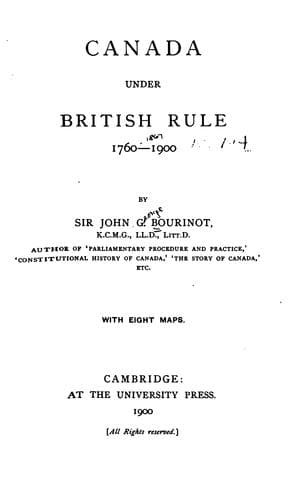
Canada under British Rule 1760-1900Bourinot, John George
History
Canada under British Rule 1760-1900
Bourinot, John George
Canada -- History
principles of justice and humanity, and would have the best effect in
quieting the minds and promoting the happiness of our Canadian
subjects." In French Canada the act was received without any popular
demonstration by the French Canadians, but the men to whom the great
body of that people always looked for advice and guidance--the priests,
curés, and seigniors--naturally regarded these concessions to their
nationality as giving most unquestionable evidence of the considerate
and liberal spirit in which the British government was determined to
rule the province. They had had ever since the conquest satisfactory
proof that their religion was secure from all interference, and now the
British parliament itself came forward with legal guarantees, not only
for the free exercise of that religion, with all its incidents and
tithes, but also for the permanent establishment of the civil law to
which they attached so much importance. The fact that no provision was
made for a popular assembly could not possibly offend a people to whom
local self-government in any form was entirely unknown. It was
impossible to constitute an assembly from the few hundred Protestants
who were living in Montreal and Quebec, and it was equally impossible,
in view of the religious prejudices dominant in England and the English
colonies, to give eighty thousand French Canadian Roman Catholics
privileges which their co-religionists did not enjoy in Great Britain
and to allow them to sit in an elected assembly. Lord North seemed to
voice the general opinion of the British parliament on this difficult
subject, when he closed the debate with an expression of "the earnest
hope that the Canadians will, in the course of time, enjoy as much of
our laws and as much of our constitution as may be beneficial to that
country and safe for this", but "that time," he concluded, "had not yet
come." It does not appear from the evidence before us that the British
had any other motive in passing the Quebec Act than to do justice to
the French Canadian people, now subjects of the crown of England. It was
not a measure primarily intended to check the growth of popular
institutions, but solely framed to meet the actual conditions of a
people entirely unaccustomed to the working of representative or popular
institutions. It was a preliminary step in the development of
self-government.
Public-domain text, read in full here on John Shaqi.
Reviews
Reviews
No reviews yet
Be the first to share your thoughts on this work.
Join the Discussion
Join the discussion
Sign in to leave a comment or review.
Sign InorCreate an account