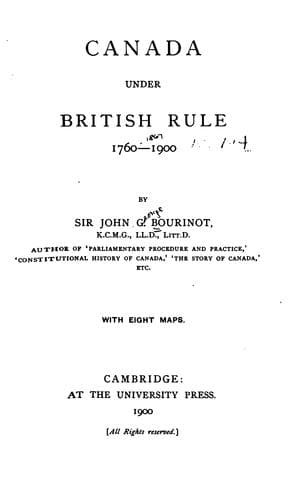
Canada under British Rule 1760-1900Bourinot, John George
History
Canada under British Rule 1760-1900
Bourinot, John George
Canada -- History
Much learning has been devoted to the elucidation of the Icelandic
Sagas, or vague accounts of voyages which Bjorne Heriulfson and Lief
Ericsson, sons of the first Norse settlers of Greenland, are supposed to
have made at the end of the tenth century, to the eastern parts of what
is now British North America, and, in the opinion of some writers, even
as far as the shores of New England. It is just possible that such
voyages were made, and that Norsemen were the first Europeans who saw
the eastern shores of Canada. It is quite certain, however, that no
permanent settlements were made by the Norsemen in any part of these
countries; and their voyages do not appear to have been known to
Columbus or other maritime adventurers of later times, when the veil of
mystery was at last lifted from the western limits of what was so long
truly described as the "sea of darkness." While the subject is
undoubtedly full of interest, it is at the same time as illusive as the
_fata morgana_, or the lakes and rivers that are created by the mists of
a summer's eve on the great prairies of the Canadian west.
Five centuries later than the Norse voyagers, there appeared on the
great field of western exploration an Italian sailor, Giovanni Caboto,
through whose agency England took the first step in the direction of
that remarkable maritime enterprise which, in later centuries, was to be
the admiration and envy of all other nations. John Cabot was a Genoese
by birth and a Venetian citizen by adoption, who came during the last
decade of the fifteenth century, to the historic town of Bristol.
Eventually he obtain from Henry VII letters-patent, granting to himself
and his three sons, Louis, Sebastian, and Sancio, the right, "at their
own cost and charges, to seek out and discover unknown lands," and to
acquire for England the dominion over the countries they might discover.
Early in May, 1497, John Cabot sailed from Bristol in "The Matthew,"
manned by English sailors. In all probability he was accompanied by
Sebastian, then about 21 years of age, who, in later times, through the
credulity of his friends and his own garrulity and vanity, took that
place in the estimation of the world which his father now rightly fills.
Some time toward the end of June, they made a land-fall on the
north-eastern coast of North America. The actual site of the land-fall
will always be a matter of controversy unless some document is found
among musty archives of Europe to solve the question to the satisfaction
of the disputants, who wax hot over the claims of a point near Cape
Chidley on the coast of Labrador, of Bonavista, on the east shore of
Newfoundland, of Cape North, or some other point, on the island of Cape
Breton. Another expedition left Bristol in 1498, but while it is now
generally believed that Cabot coasted the shores of North America from
Labrador or Cape Breton as far as Cape Hatteras, we have no details of
this famous voyage, and are even ignorant of the date when the fleet
Public-domain text, read in full here on John Shaqi.
Reviews
Reviews
No reviews yet
Be the first to share your thoughts on this work.
Join the Discussion
Join the discussion
Sign in to leave a comment or review.
Sign InorCreate an account