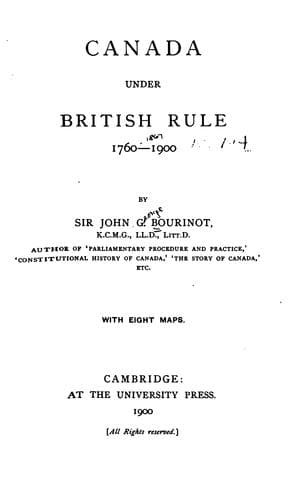
Canada under British Rule 1760-1900Bourinot, John George
History
Canada under British Rule 1760-1900
Bourinot, John George
Canada -- History
The British cabinet, of which Mr. Pitt, the famous son of the Earl of
Chatham, was first minister, now decided to divide the province of
Quebec into two districts, with separate legislatures and governments.
Lord Grenville, while in charge of the department of colonial affairs,
wrote in 1789 to Lord Dorchester that the "general object of the plan is
to assimilate the constitution of the province to that of Great Britain
as nearly as the differences arising from the names of the people and
from the present situation of the province will admit." He also
emphatically expressed the opinion that "a considerable degree of
attention is due to the prejudices and habits of the French inhabitants,
and every degree of caution should be used to continue to them the
enjoyment of those civil and religious rights which were secured to them
by the capitulation of the province, or have since been granted by the
liberal and enlightened spirit of the British government." When the bill
for the formation of the two provinces of Upper Canada and Lower Canada
came before the house of commons, Mr. Adam Lymburner, an influential
merchant of Quebec, appeared at the Bar and ably opposed the separation
"as dangerous in every point of view to British interests in America,
and to the safety, tranquillity and prosperity of the inhabitants of the
province of Quebec" He pressed the repeal of the Quebec act in its
entirety and the enactment of a perfectly new constitution "unclogged
and unembarrassed with any laws prior to this period" He professed to
represent the views "of the most intelligent and respectable of the
French Canadians"; but their antagonism was not directed against the
Quebec act in itself, but against the administration of the law,
influenced as this was by the opposition of the British people to the
French civil code. Nor does it appear, as Mr. Lymburner asserted, that
the western Loyalists were hostile to the formation of two distinct
provinces. He represented simply the views of the English-speaking
inhabitants of Lower Canada, who believed that the proposed division
would place them in a very small minority in the legislature and, as the
issue finally proved, at the mercy of the great majority of the French
Canadian representatives, while on the other hand the formation of one
large province extending from Gaspé to the head of the great lakes would
ensure an English representation sufficiently formidable to lessen the
danger of French Canadian domination. However, the British government
seems to have been actuated by a sincere desire to do justice to the
French Canadians and the Loyalists of the upper province at one and the
same time. When introducing the bill in the house of commons on the 7th
March, 1791, Mr. Pitt expressed the hope that "the division would remove
the differences of opinion which had arisen between the old and new
inhabitants, since each province would have the right of enacting laws
Public-domain text, read in full here on John Shaqi.
Reviews
Reviews
No reviews yet
Be the first to share your thoughts on this work.
Elsewhere in the archive
Join the Discussion
Join the discussion
Sign in to leave a comment or review.
Sign InorCreate an account