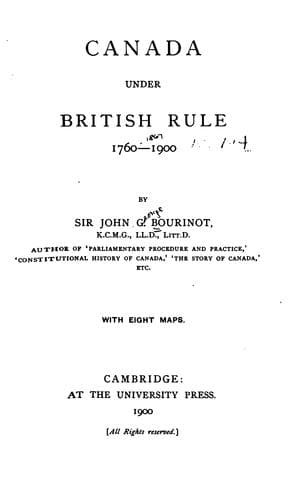
Canada under British Rule 1760-1900Bourinot, John George
History
Canada under British Rule 1760-1900
Bourinot, John George
Canada -- History
desired in its own house of assembly." He believed a division to be
essential, as "otherwise he could not reconcile the clashing interests
known to exist." Mr. Burke was of opinion that "to attempt to amalgamate
two populations composed of races of men diverse in language, laws and
customs, was a complete absurdity", and he consequently approved of the
division. Mr. Fox, from whom Burke became alienated during this debate,
looked at the question in an entirely different light and was strongly
of opinion that "it was most desirable to see the French and English
inhabitants coalesce into one body, and the different distinctions of
people extinguished for ever."
The Constitutional act of 1791 established in each province a
legislative council and assembly, with powers to make laws. The
legislative council was to be appointed by the king for life, in Upper
Canada it was to consist of not less than seven, and in Lower Canada of
not less than fifteen members. The sovereign might, if he thought
proper, annex hereditary titles of honour to the right of being summoned
to the legislative council in either province--a provision which was
never brought into operation. The whole number of members in the
assembly of Upper Canada was not to be less than sixteen; in Lower
Canada not less than fifty--to be chosen by a majority of votes in
either case. The British parliament reserved to itself the right of
levying and collecting customs-duties, for the regulation of navigation
and commerce to be carried on between the two provinces, or between
either of them and any other part of the British dominions or any
foreign country. Parliament also reserved the power of directing the
payment of these duties, but at the same time left the exclusive
apportionment of all moneys levied in this way to the legislature, which
could apply them to such public uses as it might deem expedient. The
free exercise of the Roman Catholic religion was guaranteed permanently.
The king was to have the right to set apart, for the use of the
Protestant clergy in the colony, a seventh part of all uncleared crown
lands. The governor might also be empowered to erect parsonages and
endow them, and to present incumbents or ministers of the Church of
England. The English criminal law was to obtain in both provinces.
Public-domain text, read in full here on John Shaqi.
Reviews
Reviews
No reviews yet
Be the first to share your thoughts on this work.
Elsewhere in the archive
Join the Discussion
Join the discussion
Sign in to leave a comment or review.
Sign InorCreate an account