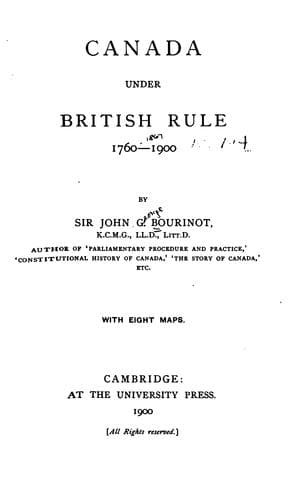
Canada under British Rule 1760-1900Bourinot, John George
History
Canada under British Rule 1760-1900
Bourinot, John George
Canada -- History
The causes of the war of 1812-15 must be sought in the history of Europe
and the relations between England and the United States for several
decades before it actually broke out. Great Britain was engaged in a
supreme struggle not only for national existence but even for the
liberties of Europe, from the moment when Napoleon, in pursuance of his
overweening ambition, led his armies over the continent on those
victorious marches which only ended amid the ice and snow of Russia.
Britain's battles were mainly to be fought on the sea where her great
fleet made her supreme. The restriction of all commerce that was not
British was a necessary element in the assertion of her naval
superiority. If neutral nations were to be allowed freely to carry the
produce of the colonies of Powers with whom Great Britain was at war,
then they were practically acting as allies of her enemies, and were
liable to search and seizure. For some time, however, Great Britain
thought it expedient to concur in the practice that when a cargo was
trans-shipped in the United States, and paid a duty there, it became to
all intents and purposes American property and might be carried to a
foreign country and there sold, as if it were the actual produce of the
republic itself. This became a very profitable business to the merchants
of the United States, as a neutral nation, during the years when Great
Britain was at war with France, since they controlled a large proportion
of all foreign commerce. Frauds constantly occurred during the
continuance of this traffic, and at last British statesmen felt the
injury to their commerce was so great that the practice was changed to
one which made American vessels liable to be seized and condemned in
British prize courts whenever it was clear that their cargoes were not
American produce, but were actually purchased at the port of an enemy.
Even provisions purchased from an enemy or its colonies were considered
"contraband of war" on the ground that they afforded actual aid and
encouragement to an enemy. The United States urged at first that only
military stores could fall under this category, and eventually went so
far as to assert the principle that under all circumstances "free ships
make free goods," and that neutral ships had a right to carry any
property, even that of a nation at war with another power, and to trade
when and where they liked without fear of capture. England, however,
would not admit in those days of trial principles which would
practically make a neutral nation an ally of her foe. She persisted in
restricting the commerce of the United States by all the force she had
upon the sea.
Public-domain text, read in full here on John Shaqi.
Reviews
Reviews
No reviews yet
Be the first to share your thoughts on this work.
Elsewhere in the archive
Join the Discussion
Join the discussion
Sign in to leave a comment or review.
Sign InorCreate an account