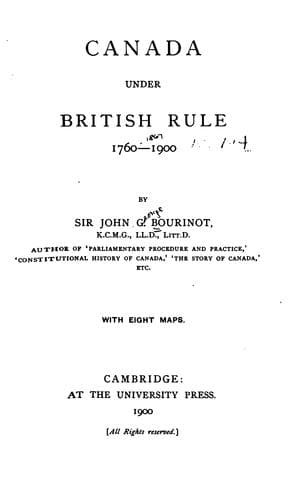
Canada under British Rule 1760-1900Bourinot, John George
History
Canada under British Rule 1760-1900
Bourinot, John George
Canada -- History
This restrictive policy, which touched the American pocket and
consequently the American heart so deeply, was complicated by another
question of equal, if not greater, import. The forcible impressment of
men to man the British fleet had been for many years a necessary evil in
view of the national emergency, and of the increase in the mercantile
marine which attracted large numbers to its service. Great abuses were
perpetrated in the operation of this harsh method of maintaining an
efficient naval force, and there was no part of the British Isles where
the presence of a press gang did not bring dismay into many a home.
Great Britain, then and for many years later, upheld to an extreme
degree the doctrine of perpetual allegiance; she refused to recognise
the right of any of her citizens to divest themselves of their national
fealty and become by naturalisation the subject of a foreign power or a
citizen of the United States Such a doctrine was necessarily most
obnoxious to the government and people of a new republic like the United
States, whose future development rested on the basis of a steady and
large immigration, which lost much of its strength and usefulness as
long as the men who came into the country were not recognised as
American citizens at home and abroad. Great Britain claimed the right,
as a corollary of this doctrine of indefeasible allegiance, to search
the neutral ships of the United States during the war with France, to
enquire into the nationality of the seaman on board of those vessels, to
impress all those whom her officers had reason to consider British
subjects by birth, and to pay no respect to the fact that they may have
been naturalised in the country of their adoption. The assertion of the
right to search a neutral vessel and to impress seamen who were British
subjects has in these modern times been condemned as a breach of the
sound principle, that a right of search can only be properly exercised
in the case of a neutral's violation of his neutrality--that is to say,
the giving of aid to one of the parties to the war The forcible
abduction of a seaman under the circumstances stated was simply an
unwarrantable attempt to enforce municipal law on board a neutral
vessel, which was in effect foreign territory, to be regarded as sacred
and inviolate except in a case where it was brought under the operation
of a recognised doctrine of international law. Great Britain at that
critical period of her national existence would not look beyond the fact
that the acts of the United States as a neutral were most antagonistic
to the energetic efforts she was making to maintain her naval supremacy
during the European crisis created by Napoleon's ambitious designs.
Public-domain text, read in full here on John Shaqi.
Reviews
Reviews
No reviews yet
Be the first to share your thoughts on this work.
Elsewhere in the archive
Join the Discussion
Join the discussion
Sign in to leave a comment or review.
Sign InorCreate an account