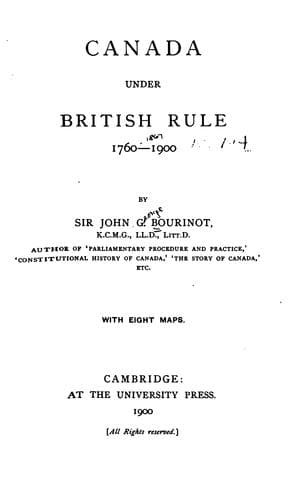
Canada under British Rule 1760-1900Bourinot, John George
History
Canada under British Rule 1760-1900
Bourinot, John George
Canada -- History
The desertion of British seamen from British ships, for the purpose of
finding refuge in the United States and then taking service in American
vessels, caused great irritation in Great Britain and justified, in the
opinion of some statesmen and publicists who only regarded national
necessities, the harsh and arbitrary manner in which English officials
stopped and searched American shipping on the high seas, seized men whom
they claimed to be deserters, and impressed any whom they asserted to be
still British subjects. In 1807 the British frigate "Leopard," acting
directly under the orders of the admiral at Halifax, even ventured to
fire a broadside into the United States cruiser "Chesapeake" a few miles
from Chesapeake Bay, killed and wounded a number of her crew, and then
carried off several sailors who were said to be, and no doubt were,
deserters from the English service and who were the primary cause of the
detention of this American man-of-war. For this unjustifiable act
England subsequently made some reparation, but nevertheless it rankled
for years in the minds of the party hostile to Great Britain and helped
to swell the list of grievances which the American government in the
course of years accumulated against the parent state as a reason for
war.
The difficulties between England and the United States, which culminated
in war before the present century was far advanced, were also
intensified by disputes which commenced soon after the treaty of 1783. I
have already shown that for some years the north-west posts were still
retained by the English on the ground, it is understood, that the claims
of English creditors, and especially those of the Loyalists, should be
first settled before all the conditions of the treaty could be carried
out. The subsequent treaty of 1794, negotiated by Chief Justice Jay,
adjusted these and other questions, and led for some years to a better
understanding with Great Britain, but at the same time led to a rupture
of friendly relations with the French Directory, who demanded the repeal
of that treaty as in conflict with the one made with France in 1778, and
looked for some tangible evidence of sympathetic interest with the
French revolution. The war that followed with the French republic was
insignificant in its operations, and was immediately terminated by
Napoleon when he overthrew the Directory, and seized the government for
his own ambitious objects. Subsequently, the administration of the
United States refused to renew the Jay Treaty when it duly expired, and
as a consequence the relatively amicable relations that had existed
between the Republic and England again became critical, since American
commerce and shipping were exposed to all the irritating measures that
England felt compelled under existing conditions to carry out in
pursuance of the policy of restricting the trade of neutral vessels.
Several attempts were made by the British government, between the expiry
Public-domain text, read in full here on John Shaqi.
Reviews
Reviews
No reviews yet
Be the first to share your thoughts on this work.
Elsewhere in the archive
Join the Discussion
Join the discussion
Sign in to leave a comment or review.
Sign InorCreate an account