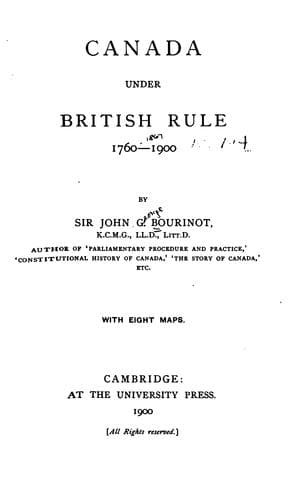
Canada under British Rule 1760-1900Bourinot, John George
History
Canada under British Rule 1760-1900
Bourinot, John George
Canada -- History
The United States had now a population of at least six millions and a
half of whites. It was estimated that during the war the government had
a militia force of between four and five hundred thousand men available
for service, while the regular army amounted to thirty-four thousand
officers and privates. The forces that invaded Canada by the way of Lake
Champlain, Sackett's Harbour, the Niagara and Detroit Rivers, were
vastly superior in numbers to the Canadian army of defence, except in
the closing months of the war, when Prevost had under his command a
large body of Peninsular veterans. One condition was always in favour of
Canada, and that was the sullen apathy or antagonism felt by the people
of New England with respect to the war. Had they been in a different
spirit, Lower Canada would have been in far greater danger of successful
invasion and occupation than was the case at any time during the
progress of the conflict. The famous march of Arnold on Quebec by the
Kennebec and Chaudière Rivers might have been repeated with more serious
consequences while Prevost, and not Guy Carleton, was in supreme command
in the French Canadian province.
I can attempt to limn only the events which stand out most plainly on
the graphic pages of this momentous epoch in Canadian history, and to
pay a humble tribute to the memory of men, whose achievements saved
Canada for England in those days of trial. From the beginning to the end
of the conflict, Upper Canada was the principal battle ground upon which
the combatants fought for the supremacy in North America. Its frontiers
were frequently crossed, its territory was invaded, and its towns and
villages were destroyed by the ruthless hand of a foe who entered the
province not only with the sword of the soldier but even with the torch
of the incendiary. The plan of operations at the outset of the campaign
was to invade the province across the Niagara and Detroit Rivers,
neither of which offered any real obstacles to the passage of a
determined and well-managed army in the absence of strong
fortifications, or a superior defensive force, at every vulnerable point
along the Canadian banks. Queenston was to be a base of operations for a
large force, which would overrun the whole province and eventually
co-operate with troops which could come up from Lake Champlain and march
on Montreal. The forces of the United States in 1812 acted with
considerable promptitude as soon as war was officially declared, and had
they been led by able commanders the result might have been most
unfortunate for Canada. The resources for defence were relatively
insignificant, and indecision and weakness were shown by Sir George
Prevost, then commander-in-chief and governor-general--a well meaning
man but wanting in ability as a military leader, who was also hampered
by the vacillating counsels of the Liverpool administration, which did
not believe in war until the province was actually invaded. It was
Public-domain text, read in full here on John Shaqi.
Reviews
Reviews
No reviews yet
Be the first to share your thoughts on this work.
Elsewhere in the archive
Join the Discussion
Join the discussion
Sign in to leave a comment or review.
Sign InorCreate an account