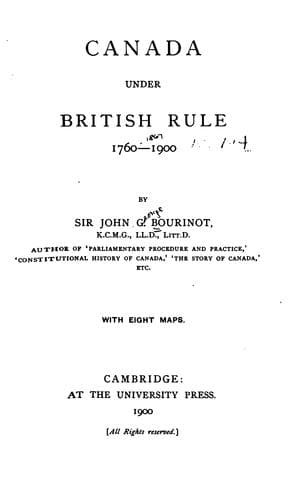
Canada under British Rule 1760-1900Bourinot, John George
History
Canada under British Rule 1760-1900
Bourinot, John George
Canada -- History
fortunate for Canada that she had then at the head of the government in
the upper province General Brock, who possessed decision of character
and the ability to comprehend the serious situation of affairs at a
critical juncture, when his superiors both in England and Canada did
not appear to understand its full significance.
The assembly of Upper Canada passed an address giving full expression to
the patriotic sentiments which animated all classes of people when the
perilous state of affairs and the necessity for energetic action became
apparent to the dullest minds. The Loyalists and their descendants, as
well as other loyal people, rallied at the moment of danger to the
support of Brock; and the immediate result of his decided orders was the
capture of the post of Michillimackinac, which had been, ever since the
days of the French régime, a position of great importance on the upper
lakes. Then followed the ignominious surrender of General Hull and his
army to Brock, and the consequent occupation of Detroit and the present
state of Michigan by the British troops. Later, on the Niagara frontier,
an army of invaders was driven from Queenston Heights, but this victory
cost the life of the great English general, whose promptitude at the
commencement of hostilities had saved the province. Among other brave
men who fell with Brock was the attorney-general of the province,
Lieutenant-Colonel John Macdonell, who was one of the general's aides.
General Sheaffe, the son of a Loyalist, took command and drove the enemy
across the river, in whose rapid waters many were drowned while
struggling to save themselves from the pursuing British soldiery,
determined to avenge the death of their honoured chief. A later attempt
by General Smyth to invade Canadian territory opposite Black Rock on the
Niagara River, was also attended with the same failure that attended the
futile attempts to cross the Detroit and to occupy the heights of
Queenston. At the close of 1812 Upper Canada was entirely free from the
army of the republic, the Union Jack floated above the fort at Detroit,
and the ambitious plan of invading the French province and seizing
Montreal was given up as a result of the disasters to the enemy in the
west. The party of peace in New England gathered strength, and the
promoters of the war had no consolation except the triumphs obtained at
sea by some heavily armed and well manned frigates of the United States
to the surprise of the government and people of England, who never
anticipated that their maritime superiority could be in any way
endangered by a nation whose naval strength was considered so
insignificant. But these victories of the republic on the ocean during
the first year of the war were soon effaced by the records of the two
subsequent years when "The Chesapeake" was captured by "The Shannon" and
other successes of the British ships restored the prestige of England on
the sea.
Public-domain text, read in full here on John Shaqi.
Reviews
Reviews
No reviews yet
Be the first to share your thoughts on this work.
Elsewhere in the archive
Join the Discussion
Join the discussion
Sign in to leave a comment or review.
Sign InorCreate an account