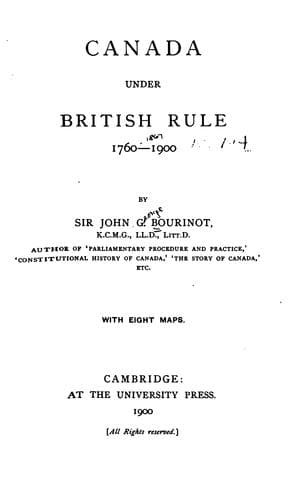
Canada under British Rule 1760-1900Bourinot, John George
History
Canada under British Rule 1760-1900
Bourinot, John George
Canada -- History
During the second year of the war the United States won some military
and naval successes in the upper province, although the final results of
the campaign were largely in favour of the defenders of Canada. The war
opened with the defeat of General Winchester at Frenchtown on the River
Raisins in the present state of Michigan; but this success, which was
won by General Procter, was soon forgotten in the taking of York, the
capital of the province, and the destruction of its public buildings.
This event forced General Sheaffe to retire to Kingston, while General
Vincent retreated to Burlington Heights as soon as the invading army
occupied Fort George and dominated the Niagara frontier. Sir George
Prevost showed his military incapacity at Sackett's Harbour, where he
had it in his power to capture a post which was an important base of
operations against the province. On the other hand Colonel George
Macdonell made a successful attack on Ogdensburg and fittingly avenged
the raid that an American force had made a short time previously on
Elizabethtown, which was called Brockville not long afterwards in honour
of the noted general. An advance of the invading army against General
Vincent was checked by the memorable success won at Stoney Creek by
Colonel Harvey and the surrender at Beaver Dams of Colonel Boerstler to
Lieutenant Fitzgibbon, whose clever strategy enabled him to capture a
large force of the enemy while in command of a few soldiers and Indians.
When September arrived, the small, though all-important, British fleet
on Lake Erie, under the command of Captain Barclay, sustained a fatal
defeat at Put-in-Bay, and the United States vessels under Commodore
Perry held full control of Lake Erie. A few weeks later, General Procter
lost the reputation which he had won in January by his defeat of
Winchester, and was beaten, under circumstances which disgraced him in
the opinion of his superiors, on the River Thames not far from the
Indian village of Moraviantown. The American forces were led by General
Harrison, who had won some reputation in the Indian campaign in the
north-west and who subsequently became, as his son in later times, a
president of the United States.
It was in this engagement that the Shawenese chief, Tecumseh, was
killed, in him England lost a faithful and brave ally. English prospects
in the west were consequently gloomy for some time, until the autumn of
1813, when the auspicious tidings spread from the lakes to the Atlantic
that the forces of the republic, while on their march to Montreal by the
way of Lake Champlain and the St. Lawrence, had been successfully met
and repulsed at Chateauguay and Chrysler's Farm, two of the most
memorable engagements of the war, when we consider the insignificant
forces that checked the invasion and saved Canada at a most critical
time.
Public-domain text, read in full here on John Shaqi.
Reviews
Reviews
No reviews yet
Be the first to share your thoughts on this work.
Elsewhere in the archive
Join the Discussion
Join the discussion
Sign in to leave a comment or review.
Sign InorCreate an account