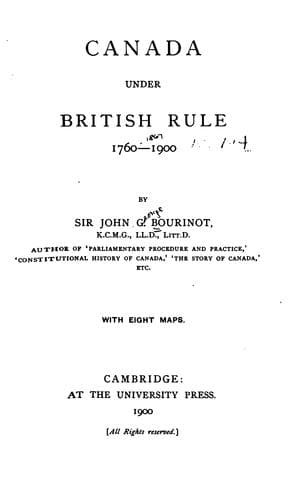
Canada under British Rule 1760-1900Bourinot, John George
History
Canada under British Rule 1760-1900
Bourinot, John George
Canada -- History
No class of the people of Canada contributed more to the effectiveness
of the militia and the successful defence of the country than the
descendants of the Loyalists, who formed so large and influential a
portion of the English population of British North America. All the
loyal settlements on the banks of the St. Lawrence, on the Niagara
frontier, and on the shores of Lake Erie, sent many men to fight by the
side of the regular British forces. Even aged men, who had borne arms in
the revolutionary war, came forward with an enthusiasm which showed that
age had not impaired their courage or patriotism, and although they were
exempted from active service, they were found most useful in stationary
duties at a time when Canada demanded the experience of such veterans.
"Their lessons and example," wrote General Sheaffe, "will have a happy
influence on the youth of the militia ranks." When Hull invaded the
province and issued his boastful and threatening proclamation he used
language which must have seemed a mockery to the children of the
Loyalists. They remembered too well the sufferings of their fathers and
brothers during "the stormy period of the revolution," and it seemed
derisive to tell them now that they were to be "emancipated from tyranny
and oppression and restored to the dignified station of free men." The
proclamation issued by Governor Brock touched the loyal hearts of a
people whose family histories were full of examples of "oppression and
tyranny," and of the kind consideration and justice of England in their
new homes. "Where," asked Brock, with the confidence of truth, "is the
Canadian subject who can truly affirm to himself that he has been
injured by the government in his person, his property, or his liberty?
Where is to be found, in any part of the world, a growth so rapid in
prosperity and wealth as this colony exhibits?" These people, to whom
this special appeal was made at this national crisis, responded with a
heartiness which showed that gratitude and affection lay deep in their
hearts. Even the women worked in the field that their husbands, brothers
and sons might drive the invaders from Canadian soil. The 104th
Regiment, which accomplished a remarkable march of thirteen days in the
depth of winter, from Fredericton to Quebec--a distance of three hundred
and fifty miles--and lost only one man by illness, was composed of
descendants of the loyal founders of New Brunswick. This march was
accomplished practically without loss, while more than three hundred
men were lost by Benedict Arnold in his expedition of 1777 against
Quebec by the way of Kennebec--a journey not more dangerous or arduous
than that so successfully accomplished by the New Brunswick Loyalists.
In 1814 considerable numbers of seamen for service in the upper lakes
passed through New Brunswick to Quebec, and were soon followed by
several companies of the 8th or King's Regiment. The patriotism of the
Public-domain text, read in full here on John Shaqi.
Reviews
Reviews
No reviews yet
Be the first to share your thoughts on this work.
Elsewhere in the archive
Join the Discussion
Join the discussion
Sign in to leave a comment or review.
Sign InorCreate an account