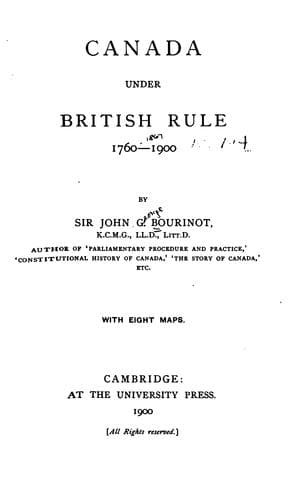
Canada under British Rule 1760-1900Bourinot, John George
History
Canada under British Rule 1760-1900
Bourinot, John George
Canada -- History
Loyalists of New Brunswick was shown by grants of public money and every
other means in their power, while these expeditions were on their way to
the seat of war in the upper provinces.
Historians and poets have often dwelt on the heroism of Laura Secord,
daughter and wife of Loyalists, who made a perilous journey in 1814
through the Niagara district, and succeeded in warning Lieutenant
Fitzgibbon of the approach of the enemy, thus enabling him with a few
soldiers and Indians to surprise Colonel Boerstler near Beaver Dams and
force him by clever strategy to surrender with nearly 600 men and
several cannon. Even boys fled from home and were found fighting in the
field. The Prince Regent, at the close of the war, expressly thanked the
Canadian militia, who had "mainly contributed to the immediate
preservation of the province and its future security." The Loyalists,
who could not save the old colonies to England, did their full share in
maintaining her supremacy in the country she still owned in the valley
of the St. Lawrence and on the shores of the Atlantic.
As Bishop Plessis stimulated a patriotic sentiment among the French
Canadians, so Vicar-General Macdonell of Glengarry, subsequently the
first Roman Catholic bishop of Upper Canada, performed good service by
assisting in the formation of a Glengarry regiment, and otherwise taking
an active part in the defence of the province, where his will always be
an honoured name. Equally indefatigable in patriotic endeavour was
Bishop Strachan, then rector of York, who established "The Loyal and
Patriotic Society," which did incalculable good by relieving the
necessities of women and children, when the men were serving in the
battlefield, by providing clothing and food for the soldiery, and
otherwise contributing towards the comfort and succour of all those who
were taking part in the public defences. Of the engagements of the war
there are two which, above all others, possess features on which the
historian must always like to dwell. The battle which was fought against
such tremendous odds on the banks of the Chateauguay by less than a
thousand French Canadians, led by Salaberry and Macdonell, recalls in
some respects the defeat of Braddock in 1755. The disaster to the
British forces near the Monongahela was mainly the result of the
strategy of the Indians, who were dispersed in the woods which reechoed
to their wild yells and their ever fatal shots fired under cover of
trees, rocks and stumps. The British were paralysed as they saw their
ranks steadily decimated by the fire of an enemy whom they could never
see, and who seemed multitudinous as their shrieks and shouts were heard
far and wide in that Bedlam of the forest. The leaves that lay thick and
deep on the ground were reddened with the blood of many victims helpless
against the concealed, relentless savages. The woods of the Chateauguay
did not present such a scene of carnage as was witnessed at the battle
Public-domain text, read in full here on John Shaqi.
Reviews
Reviews
No reviews yet
Be the first to share your thoughts on this work.
Elsewhere in the archive
Join the Discussion
Join the discussion
Sign in to leave a comment or review.
Sign InorCreate an account