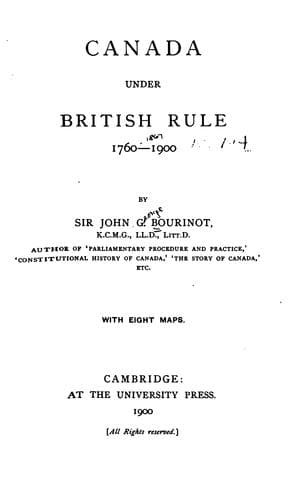
Canada under British Rule 1760-1900Bourinot, John George
History
Canada under British Rule 1760-1900
Bourinot, John George
Canada -- History
of the Monongahela, but nevertheless they seemed to the panic-stricken
invaders, who numbered many thousands, alive with an enemy whose
strength was enormously exaggerated as bugle sounds and Indian yells
made a fearful din on every side. Believing themselves surrounded by
forces far superior in numbers, the invaders became paralysed with fear
and fled in disorder from an enemy whom they could not see, and who
might close upon them at any moment. In this way Canadian pluck and
strategy won a famous victory which saved the province of Lower Canada
at a most critical moment of the war.
If we leave the woods of Chateauguay, where a monument has been raised
in recognition of this brilliant episode of the war, and come to the
country above which rises the mist of the cataract of Niagara, we see a
little acclivity over which passes that famous thoroughfare called
"Lundy's Lane." Here too rises a stately shaft in commemoration of
another famous victory--in many respects the most notable of the
war--won by a gallant Englishman, whose name still clings to the pretty
town close by.
This battle was fought on a midsummer night, when less than three
thousand British and Canadian troops fought six hours against a much
superior force, led by the ablest officers who had taken part in the
war. For three hours, from six to nine o'clock at night, less than two
thousand held the height, which was the main object of attack from the
beginning to the end of the conflict, and kept at bay the forces that
were led against them with a stern determination to win the position.
Sunlight gave way to the twilight of a July evening, and dense darkness
at last covered the combatants, but still the fight went on. Columns of
the enemy charged in such close and rapid succession that the British
artillerymen were constantly assailed in the very act of sponging and
loading their guns. The assailants once won the height, but only to find
themselves repulsed the next instant by the resolute daring of the
British. Happily at the most critical moment, when the defenders of the
hill were almost exhausted by the heroic struggle, reinforcements
arrived, and the battle was renewed with a supreme effort on both sides.
For three hours longer, from nine o'clock to midnight, the battle was
fought in the darkness, only relieved by the unceasing flashes from the
guns, whose sharp reports mingled with the deep and monotonous roar of
the great falls. It was a scene worthy of a painter whose imagination
could grasp all the incidents of a situation essentially dramatic in its
nature. The assailants of the Canadian position gave way at last and
withdrew their wearied and disheartened forces. It was in all respects a
victory for England and Canada, since the United States army did not
attempt to renew the battle on the next day, but retired to Fort Erie,
then in their possession. As Canadians look down "the corridors of
time," they will always see those flashes from the musketry and cannon
Public-domain text, read in full here on John Shaqi.
Reviews
Reviews
No reviews yet
Be the first to share your thoughts on this work.
Elsewhere in the archive
Join the Discussion
Join the discussion
Sign in to leave a comment or review.
Sign InorCreate an account