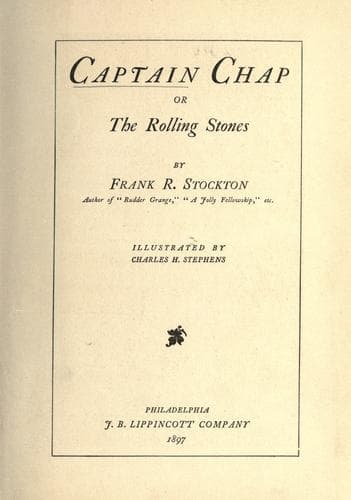
Captain Chap; or, The Rolling StonesStockton, Frank R.
General
Captain Chap; or, The Rolling Stones
Stockton, Frank R.
Florida -- Juvenile fiction; Teenage boys -- Juvenile fiction
While he was considering this matter, and blaming Phil a good deal for
his negligence, a messenger came to him from the city, sent by one
of the members of the tug-boat company, with whom he was acquainted,
telling him how the boat had gone to sea and had never returned, and
begging him to break the matter as well as he could to the Webster and
Poole families.
Poor Mr. Godfrey had grief enough of his own when he heard this
intelligence, but he did not give up hope, and hurried away to do what
he could to help and encourage his afflicted neighbors.
The Poole family were very willing to listen to Mr. Berkeley’s hopeful
words, and promised to keep up good hearts until they could hear from
him again, and even Mrs. Webster, although terribly shocked, did not
entirely despair. There never was a man who could put a brighter side
to dreary things than Mr. Godfrey Berkeley.
“But I shall die upon the spot,” she said, “if something is not done.
If I can know that somebody is doing something, I can wait in hope; but
if we are to sit here with our hands folded, I shall go crazy. I should
start off this minute myself if I knew what to do or where to go, and
if there were not so many things that make it almost impossible for me
to leave home just now.”
Mr. Godfrey assured her that something was to be done instantly, for
he was going to start for the city by the very next train; thereupon,
Helen, Chap’s only sister, who was even more grieved by the dreadful
news than her mother, although she did not say so much about it, begged
that she might go with Mr. Godfrey.
“I want to hear any news as soon as it comes,” she said. “I don’t think
I can sit still here and wait. And then, if anything is heard from
them, Mr. Godfrey may want to stay down in the city, and I can come
up and tell you. That will be ever so much better than letters and
telegrams.”
Mr. Webster was absent in the West, and as Mrs. Webster thought it very
proper that some of the family should do something in the matter, she
gave Helen permission to accompany Mr. Berkeley, who was very glad to
have for a companion this sensible and courageous girl.
In the city they heard the full particulars of the occurrence as far as
they were known.
“Has nothing been heard of the vessel which the tug-boat went out to
offer to bring in?” asked Mr. Godfrey Berkeley.
“She never came into the Breakwater at all,” was the answer. “She must
have concluded to lie-to that night, for the wind was dead against her.
She was the Cygnet, bound to Norfolk, Virginia, and we heard yesterday
that she was spoken the next day by a coasting vessel coming North.
The gale had pretty well gone down by that time, and she’d rigged up a
jury-mast, and was making her way to her port with a fair wind.”
“Mr. Godfrey,” said Helen, who had been listening attentively, “don’t
you suppose that ship might have picked up the people on the tug-boat
if they were wrecked? Perhaps Chap and the others are on board of her
now.”
Public-domain text, read in full here on John Shaqi.
Reviews
Reviews
No reviews yet
Be the first to share your thoughts on this work.
Join the Discussion
Join the discussion
Sign in to leave a comment or review.
Sign InorCreate an account