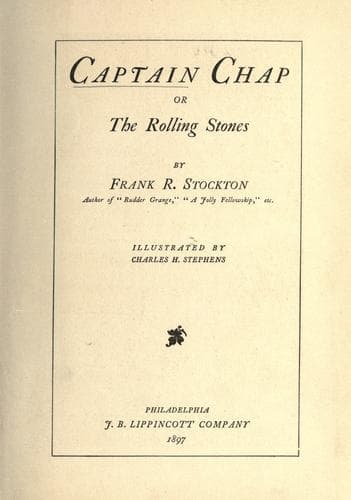
Captain Chap; or, The Rolling StonesStockton, Frank R.
General
Captain Chap; or, The Rolling Stones
Stockton, Frank R.
Florida -- Juvenile fiction; Teenage boys -- Juvenile fiction
“Just think of it, Helen!” he cried. “The captain here tells me that
the next morning after the tug-boat came out to meet him, he saw her,
with his glass, tossing about on the waves a long way off. He knew she
must have been blown out to sea by the storm, and he kept watch on her.
She was so far away that the people on board of her could not have seen
his vessel if they had not a good ship’s glass. He was sure she was
disabled, and would have gone to her assistance if he had not been
disabled himself. But now, hear this--this is the splendid part. Some
time afterward, he saw a steamship come along, and as he kept his glass
on the spot he saw the steamer lie-to and take people off the tug-boat.
Of course, she took everybody. And then she started on her way South.
He says he is quite sure she is a Savannah steamer.”
“Oh, Mr. Godfrey,” cried Helen, clapping her hands, “this is glorious!
Let’s go straight to Savannah!”
“Why, you madcap girl,” laughed Mr. Berkeley, “I believe you would
follow those fellows all round the world!”
“Indeed I would,” said Helen, “if I could only be sure of meeting dear
Chap at last!”
When they went back to the hotel, Mr. Berkeley actually considered this
plan of going to Savannah. He calculated that the steamer should have
arrived at that port some days before, and if the boys were there, they
were probably in trouble, for, otherwise, they certainly should have
been heard from.
He could not imagine why they had not telegraphed or written. His joy,
therefore, at the news given him by the captain of the Cygnet, was
much dampened after this careful consideration of the case. At any
rate, he determined to go to Savannah. If the steamer was really bound
there, the boys ought to be looked after, and he felt, as well as Mrs.
Webster, that something ought to be doing until they were found.
Of course, he had to take Helen with him, as he could not send her home
alone, and having telegraphed the Cygnet’s news to Boontown, the two
started for Savannah that afternoon.
When they reached that city, Mr. Berkeley made diligent inquiries in
regard to the arrival of three shipwrecked boys, but he heard that only
two steamers had come in within a week, and that neither of these had
fallen in with a disabled tug-boat.
When even his stout heart was beginning to despair, and poor Helen
looked as if she had been ill for a month, there came a telegram from
Boontown. It was from Mr. Welford, a banker of that place, and a friend
of Mr. Berkeley’s, to whom the telegram had been addressed which the
boys had forwarded by the sportsman they had met on the Indian River.
Mr. Welford lived in the town, and a telegram sent to him would be
immediately delivered, and the boys knew he would lose no time in
notifying their families.
The telegram now received from Mr. Welford informed Mr. Godfrey
Berkeley that the boys were on the Indian River, Florida, and were
coming North as fast as possible.
Public-domain text, read in full here on John Shaqi.
Reviews
Reviews
No reviews yet
Be the first to share your thoughts on this work.
Join the Discussion
Join the discussion
Sign in to leave a comment or review.
Sign InorCreate an account