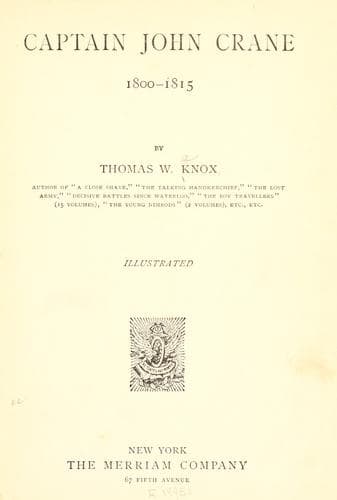
United States -- History -- War of 1812 -- Fiction
The Warwick had sailed from Rio Janeiro nearly a year before, her
destination being London. She had been caught in the calms just south
of the equator, and lay there without moving a mile for several weeks
together. Then she got a breeze that carried her two or three degrees
north; the breeze died away, and left her in the doldrums as before.
For ten weeks she was held there as though she had been anchored, in
the terrific heat that prevails at the equator. She had two passengers,
an Englishman and his wife, on their way home from Brazil. Both of them
sickened and died from the effects of the heat, the wife being the
first to go. Three of the sailors, and also the second mate, became ill
during this period; and though they survived the period of calms they
never recovered; but died not long after. After a time a wind sprang up
which carried the ship to the northward, out of the equatorial belt of
calms and into the winds of the tropics.
Then followed a series of gales, some of them reaching the severity of
hurricanes. The ship was damaged considerably by the gales, and on two
or three occasions it was thought she would founder and carry with her
to the bottom of the ocean every one on board. At starting the Warwick
had taken provisions and water for six months, expecting long before
the end of that period to be safely anchored in the Thames.
She was blown far out of her course, water and provisions ran short,
the crew were put on half rations, and afterwards on quarter rations,
and on the day we sighted her not one of her party had drunk or eaten
anything for nearly twenty-four hours. Starvation, or what is nearly as
bad, cannibalism, stared the unfortunate mariners in the face; and Mr.
Johnson, our second mate, was no doubt within bounds when he said that
not one of the party could have survived forty-eight hours longer.
Several deaths had already occurred from lack of food and drink; the
captain died a week before the encounter of the ships, and the second
mate died on the same day. All the men had succumbed except those I
have mentioned,--the four that Mr. Johnson found on deck, four in the
forecastle, and the first mate in the captain's cabin.
It was plain that the crew of the Warwick, exhausted as they were by
famine and death, would be unable to navigate the ship safely to port.
When we met them they were drifting much more than sailing; the weather
had been very mild for the past fortnight, so the Warwick's mate told
us, and it was due to this circumstance, he added, that they were alive.
"If a gale had come up," said he, "we couldn't have done anything to
meet it. We couldn't have stowed a sail or tautened a brace, and there
isn't strength enough in all the crew together to put the ship's wheel
hard over and hold it there. You'll have to take us into port, or else
stay by us till we get strength enough to do it ourselves."
Public-domain text, read in full here on John Shaqi.
Reviews
Reviews
No reviews yet
Be the first to share your thoughts on this work.
Join the Discussion
Join the discussion
Sign in to leave a comment or review.
Sign InorCreate an account