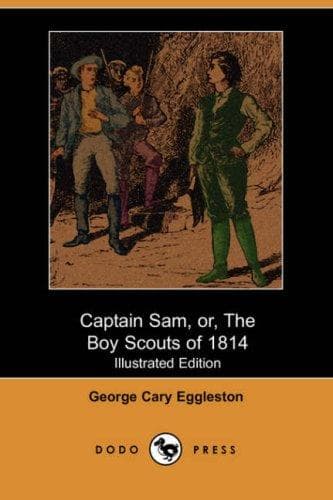
Captain Sam: The Boy Scouts of 1814Eggleston, George Cary
History
Captain Sam: The Boy Scouts of 1814
Eggleston, George Cary
United States -- History -- War of 1812 -- Fiction
"At present I am not even a private," replied Sam, "though the boys
call me Captain Sam."
"Do they? Then Captain Sam it shall be, and I wish you a successful
campaign before Pensacola, Captain. Get your forces into marching
order at once. Take all of your boys, unless some of them have
already enlisted,--it won't do to take actual soldiers with you, as
yours must be a citizen's camp,--and march as early as you can. I'll
see that you are properly provided with the tools you need."
CHAPTER VI.
CAPTAIN SAM BEGINS HIS MARCH.
At noon the next day Sam marched away from the camp at the head of his
little company, reduced now to precisely six boys in all, counting the
colored boy Joe, but not counting Captain Sam himself. Jake Elliott
was one of the company, rather against Sam's wish, but he had begged
for permission to go, and Sam thought his size and strength might be
of use in some emergency. Tommy was of the party of course, and the
other boys were Billy Bunker--called Billy Bowlegs by the boys,
because he was not bow-legged at all but on the contrary badly
knock-kneed,--Bob Sharp, a boy of about Tommy's size and age, and
Sidney Russell, a boy of thirteen, who had "run to legs," his
companions said, and was already nearly six feet high, and so slender
that, notwithstanding his extreme height, he was the lightest boy in
the company. The rest of the party had already enlisted and could not
go.
The outfit was complete, after Sam's notions of completeness; that is
to say, it included every thing which was absolutely necessary and not
an ounce of anything that could be safely spared. For tools they had
two axes, with rather short handles, a small hatchet, a pocket rule
and an adze; to this list might be added their large pocket knives,
which every man and boy on the frontier carries habitually. For camp
utensils each boy had a tin cup and that was all, except a single
light skillet, which they were to carry alternately, as they were to
do with the tools. Each boy carried a blanket tightly rolled up, and
each had, at the start, eight pounds of corn meal and four pounds of
bacon, with a small sack of salt each, which could be carried in any
pocket. This was all. They had no arms and no ammunition.
Public-domain text, read in full here on John Shaqi.
Reviews
Reviews
No reviews yet
Be the first to share your thoughts on this work.
Join the Discussion
Join the discussion
Sign in to leave a comment or review.
Sign InorCreate an account