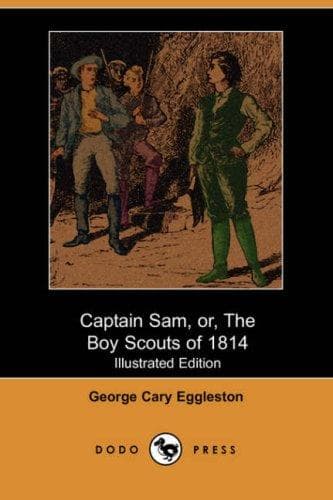
Captain Sam: The Boy Scouts of 1814Eggleston, George Cary
History
Captain Sam: The Boy Scouts of 1814
Eggleston, George Cary
United States -- History -- War of 1812 -- Fiction
"Well, but it won't reach; you've got to reach all the joints you
know, and the rod must be as long as the cane."
"Oh no, not by any means."
"Yes it must, of course it must," exclaimed all the boys in a breath.
"It's just like burning out a pipe stem with a wire."
"No it is not," replied Sam, smiling, "but suppose it is. I can burn
out a pipe stem with a wire half as long as the stem."
"How?" asked two or three boys at once.
"By burning first from one end and then from the other."
"Yes, that's so," answered Sid Russell slowly, drawling his words out
as if he had to drag them up through his long legs, "but that don't
tell how you're goin' to bore out a big cane, fifteen feet long with a
little iron rod not more 'n six or eight inches long."
"Well, if you will be patient a moment, I'll show you," answered Sam,
picking up the bit of iron. Trimming off the end of one of his small
green canes, Sam measured it by the iron rod and trimmed again. He
continued this process until he had the end of the cane a trifle
larger than the iron was. Then taking an iron tube or band out of his
pocket, he drove the iron rod firmly into it for the distance of about
half an inch, leaving the other end of the tube open. Into this he
forced the end of the small green cane and having made it firm he had
a rod about ten feet long.
"There," he said, "I have a rod long enough to reach a good deal more
than half way through either one of my big canes. It isn't iron except
at the end, and it doesn't need to be," and with that he thrust the
end of the bit of iron into the fire to heat.
"Now, Tom," he said, "you must burn the canes out while I do something
else."
I wonder if there is any boy who needs a fuller explanation than the
one which Sam has already given, of what was going forward. There may
be boys enough, for aught I know, who never went fishing in their
lives, and so do not know what canes, or reeds, or cane-poles, as
they are variously called, are like. I must explain, therefore, that
the canes which Sam proposed to burn out, were precisely such as those
that are commonly used as fishing rods. These canes grow all over the
South, in the swamps. They are, in fact, a kind of gigantic grass,
although the people who are most familiar with them do not dream of
the fact. The botanists call them a grass, at any rate, and the
botanists know. Each cane is a long, straight rod, tapering very
gently, with "joints," as they are called, about eight or ten inches
apart. These joints are simply places where the cane, outside, is a
little larger than it is between joints, while inside each joint
consists of a hard woody partition, across the hollow tube, which is
otherwise continuous. Sam's plan was simply to burn these partitions
away with a hot iron, which would convert the cane into a long,
slender, wooden tube, very hard, very light, and straight as an arrow.
Public-domain text, read in full here on John Shaqi.
Reviews
Reviews
No reviews yet
Be the first to share your thoughts on this work.
Join the Discussion
Join the discussion
Sign in to leave a comment or review.
Sign InorCreate an account