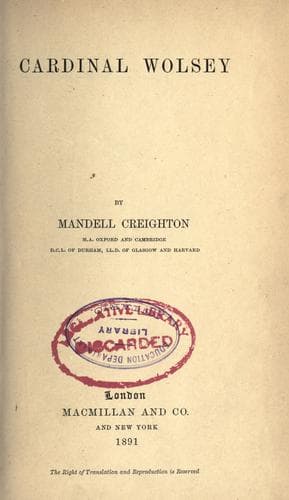
Thomas Wolsey was born at Ipswich, probably in March 1471. He was the
son of Robert Wolsey and Joan his wife. Contemporary slander, wishing to
make his fortunes more remarkable or his presumption more intolerable,
represented his father as a man of mean estate, a butcher by trade.
However, Robert Wolsey's will shows that he was a man of good position,
probably a grazier and wool merchant, with relatives who were also
well-to-do. Thomas seems to have been the eldest of his family, and his
father's desire was that he should enter the priesthood. He showed
quickness in study; so much so that he went to Oxford at the early age
of eleven, and became Bachelor of Arts when he was fifteen. His studies
do not seem to have led him in the direction of the new learning; he was
well versed in the theology of the schools, and is said to have been a
devoted adherent to the system of St. Thomas Aquinas. But it was not by
the life of a student or the principles of a philosopher that Wolsey
rose to eminence. If he learned anything in his University career he
learned a knowledge of men and of their motives.
In due course he became a Fellow of Magdalen, and master of the grammar
school attached to the College. Soon afterwards, in 1498, he was bursar;
and tradition has connected with him the building of the graceful tower
which is one of the chief architectural ornaments of Oxford.
Unfortunately the tower was finished in the year in which Wolsey became
bursar, and all that he can have done was the prosaic duty of paying the
bills for its erection. He continued his work of schoolmaster till in
1500 the Marquis of Dorset, whose sons Wolsey had taught, gave him the
living of Lymington in Somerset.
So Wolsey abandoned academic life for the quietness of a country living,
which, however, did not prove to be entirely free from troubles. For
some reason which is not clear, a neighbouring squire, Sir Amyas Paulet,
used his power as justice of peace to set Wolsey in the stocks, an
affront which Wolsey did not forgive, but in the days of his power
punished by confining Sir Amyas to his London house, where he lived for
some years in disgrace. If this story be true, it is certainly not to
Wolsey's discredit, who can have been moved by nothing but a sense of
injustice in thus reviving the remembrance of his own past history.
Moreover, Wolsey's character certainly did not suffer at the time, as in
1501 he was made chaplain to Dean, Archbishop of Canterbury. After
Dean's death in 1503, his capacity for business was so far established
that he was employed by Sir Richard Nanfan, Deputy-Lieutenant of Calais,
to help him in the duties of a post which advancing years made somewhat
onerous. When Nanfan, a few years afterwards, retired from public life,
he recommended Wolsey to the king, and Wolsey entered the royal service
as chaplain probably in 1506.
Public-domain text, read in full here on John Shaqi.
Reviews
Reviews
No reviews yet
Be the first to share your thoughts on this work.
Join the Discussion
Join the discussion
Sign in to leave a comment or review.
Sign InorCreate an account