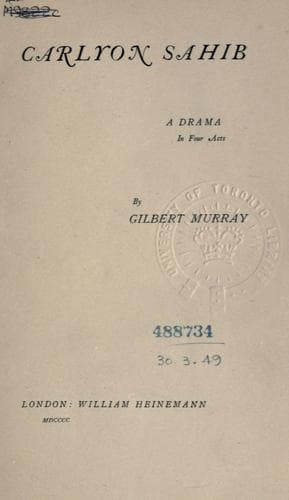
Carlyon Sahib: A Drama in Four ActsMurray, Gilbert
General
Carlyon Sahib: A Drama in Four Acts
Murray, Gilbert
English drama -- 19th century
Bah! and however bad. I do not like your great men; I am not a world
conqueror. I am just like other people, and I expect other people to be
just like me. I do not overcrush my fellow creatures. A fool contradicts
me, and I submit to the argumentation of that fool! [ADENE _tries to
speak, but_ RHEINHARDT _checks him with a gesture_.] A cow charges upon
me, and I run myself away from that cow; I do not say, "I, Rheinhardt,
am Almighty!" You say this Sir Carlyon is a great man; you will say
Steinmetz is a great man----
ADENE.
No, I won't, I'll believe anything you like to tell me about Steinmetz.
RHEINHARDT.
You contradict me flatly when I speak! I tell you Steinmetz is an
arrogant man, a rash man, an ingenious man, a clumsy man. You show me
what you call his road-making experimentations! I tell you that I behold
so many miserable assassinates! If he is a great man, I am a great man
myself!
_Re-enter_ CARLYON _with_ VERA, _her arm round his waist_, L.
ADENE.
I am sure you are.
RHEINHARDT.
Sir, you insult me!
CARLYON.
Here I am! Will you come too, Rheinhardt?
RHEINHARDT.
No, I will not! I will talk to my pupil. Go!
[_Exeunt_ CARLYON _and_ ADENE _down garden right_. ELIZABETH _appears on
the steps, looking after_ CARLYON, _then withdraws again_.
RHEINHARDT.
So you see I have come. I started so soon as I got your letter.
VERA.
I am very, very grateful to you. I do so hope I may be wrong.
RHEINHARDT.
He does not show much sign of it.
VERA.
He has such self-command.
RHEINHARDT.
Not at all! He is irritable and contradicts me much.
VERA.
I had not noticed him irritable. He is sometimes depressed.
RHEINHARDT.
I tell you he is irritable. You must be careful not to excite him, not
to contradict him; bah, let little things pass! [_With a sweep of the
hand._
VERA.
Then you think from what I have told you that it really is so?
RHEINHARDT.
How can I say? The evidences are much too small. Have you examined him
again?
VERA.
I managed it again yesterday. I think it's even clearer; of course I
can't be sure.
RHEINHARDT.
You have watched him in daily life? Yes?
VERA.
Of course. I have a good many notes for you to see.
RHEINHARDT.
He does not suspect anything?
VERA.
Nothing. He says he is overworked; but you would never know from himself
that he was at all ill.
RHEINHARDT.
That is right, of course he must not be told.
VERA.
It has no effect on a glioma, has it? For the patient to know?
RHEINHARDT.
What do _you_ know about gliomas? What do you know about any tumour on
the brain at all?
VERA.
I only asked.
RHEINHARDT.
Of course he must not know!---- You say his knowledge does not make the
glioma worse. No, but it makes the effects worse! It strikes the man
down; it is a moral paralysis, when he knows he has a mortal disease.
You say it does not bring death nearer? What do you call it if a man has
no spirit left in him, no courage, no interest in life? You say it is
not important----
VERA.
Please, I never said so.
Public-domain text, read in full here on John Shaqi.
Reviews
Reviews
No reviews yet
Be the first to share your thoughts on this work.
Join the Discussion
Join the discussion
Sign in to leave a comment or review.
Sign InorCreate an account