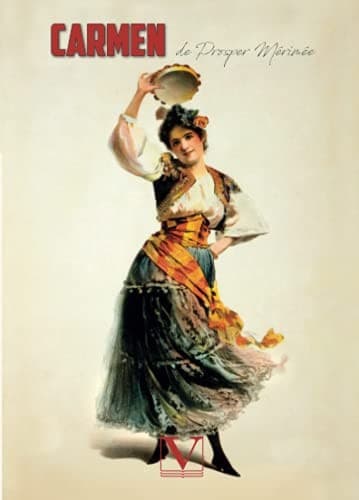
Carmen (Fictitious character) -- Fiction; Spain -- Social life and customs -- 19th century -- Fiction
CARMEN
by Prosper Merimee
Translated by Lady Mary Loyd
CHAPTER I
I had always suspected the geographical authorities did not know what
they were talking about when they located the battlefield of Munda in
the county of the Bastuli-Poeni, close to the modern Monda, some two
leagues north of Marbella.
According to my own surmise, founded on the text of the anonymous author
of the _Bellum Hispaniense_, and on certain information culled from the
excellent library owned by the Duke of Ossuna, I believed the site of
the memorable struggle in which Caesar played double or quits, once and
for all, with the champions of the Republic, should be sought in the
neighbourhood of Montilla.
Happening to be in Andalusia during the autumn of 1830, I made a
somewhat lengthy excursion, with the object of clearing up certain
doubts which still oppressed me. A paper which I shall shortly publish
will, I trust, remove any hesitation that may still exist in the minds
of all honest archaeologists. But before that dissertation of mine
finally settles the geographical problem on the solution of which the
whole of learned Europe hangs, I desire to relate a little tale. It will
do no prejudice to the interesting question of the correct locality of
Monda.
I had hired a guide and a couple of horses at Cordova, and had
started on my way with no luggage save a few shirts, and Caesar’s
_Commentaries_. As I wandered, one day, across the higher lands of the
Cachena plain, worn with fatigue, parched with thirst, scorched by a
burning sun, cursing Caesar and Pompey’s sons alike, most heartily, my
eye lighted, at some distance from the path I was following, on a little
stretch of green sward dotted with reeds and rushes. That betokened the
neighbourhood of some spring, and, indeed, as I drew nearer I perceived
that what had looked like sward was a marsh, into which a stream, which
seemed to issue from a narrow gorge between two high spurs of the Sierra
di Cabra, ran and disappeared.
If I rode up that stream, I argued, I was likely to find cooler water,
fewer leeches and frogs, and mayhap a little shade among the rocks.
At the mouth of the gorge, my horse neighed, and another horse,
invisible to me, neighed back. Before I had advanced a hundred paces,
the gorge suddenly widened, and I beheld a sort of natural amphitheatre,
thoroughly shaded by the steep cliffs that lay all around it. It was
impossible to imagine any more delightful halting place for a traveller.
At the foot of the precipitous rocks, the stream bubbled upward and fell
into a little basin, lined with sand that was as white as snow. Five or
six splendid evergreen oaks, sheltered from the wind, and cooled by the
spring, grew beside the pool, and shaded it with their thick foliage.
And round about it a close and glossy turf offered the wanderer a better
bed than he could have found in any hostelry for ten leagues round.
Public-domain text, read in full here on John Shaqi.
Reviews
Reviews
No reviews yet
Be the first to share your thoughts on this work.
Join the Discussion
Join the discussion
Sign in to leave a comment or review.
Sign InorCreate an account