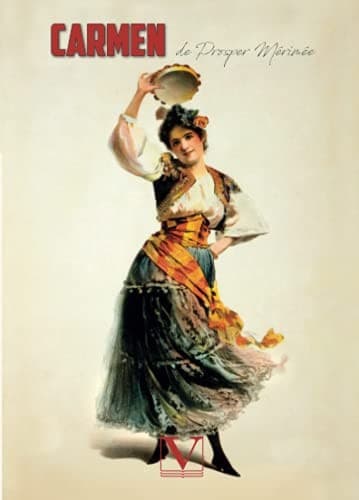
Carmen (Fictitious character) -- Fiction; Spain -- Social life and customs -- 19th century -- Fiction
Various considerations prevented me from going to claim it next day, or
requesting the _Corregidor_ to be good enough to have a search made
for it. I finished my work on the Dominican manuscript, and went on
to Seville. After several months spent wandering hither and thither in
Andalusia, I wanted to get back to Madrid, and with that object I had to
pass through Cordova. I had no intention of making any stay there, for
I had taken a dislike to that fair city, and to the ladies who bathed
in the Guadalquivir. Nevertheless, I had some visits to pay, and certain
errands to do, which must detain me several days in the old capital of
the Mussulman princes.
The moment I made my appearance in the Dominican convent, one of the
monks, who had always shown the most lively interest in my inquiries
as to the site of the battlefield of Munda, welcomed me with open arms,
exclaiming:
“Praised be God! You are welcome! My dear friend. We all thought you
were dead, and I myself have said many a _pater_ and _ave_ (not that I
regret them!) for your soul. Then you weren’t murdered, after all? That
you were robbed, we know!”
“What do you mean?” I asked, rather astonished.
“Oh, you know! That splendid repeater you used to strike in the library
whenever we said it was time for us to go into church. Well, it has been
found, and you’ll get it back.”
“Why,” I broke in, rather put out of countenance, “I lost it--”
“The rascal’s under lock and key, and as he was known to be a man who
would shoot any Christian for the sake of a _peseta_, we were
most dreadfully afraid he had killed you. I’ll go with you to the
_Corregidor_, and he’ll give you back your fine watch. And after that,
you won’t dare to say the law doesn’t do its work properly in Spain.”
“I assure you,” said I, “I’d far rather lose my watch than have to
give evidence in court to hang a poor unlucky devil, and especially
because--because----”
“Oh, you needn’t be alarmed! He’s thoroughly done for; they might hang
him twice over. But when I say hang, I say wrong. Your thief is an
_Hidalgo_. So he’s to be garrotted the day after to-morrow, without
fail.* So you see one theft more or less won’t affect his position.
Would to God he had done nothing but steal! But he has committed several
murders, one more hideous than the other.”
* In 1830, the noble class still enjoyed this privilege.
Nowadays, under the constitutional _regime_, commoners have
attained the same dignity.
“What’s his name?”
“In this country he is only known as Jose Navarro, but he has another
Basque name, which neither your nor I will ever be able to pronounce.
By the way, the man is worth seeing, and you, who like to study the
peculiar features of each country, shouldn’t lose this chance of noting
how a rascal bids farewell to this world in Spain. He is in jail, and
Father Martinez will take you to him.”
Public-domain text, read in full here on John Shaqi.
Reviews
Reviews
No reviews yet
Be the first to share your thoughts on this work.
Join the Discussion
Join the discussion
Sign in to leave a comment or review.
Sign InorCreate an account