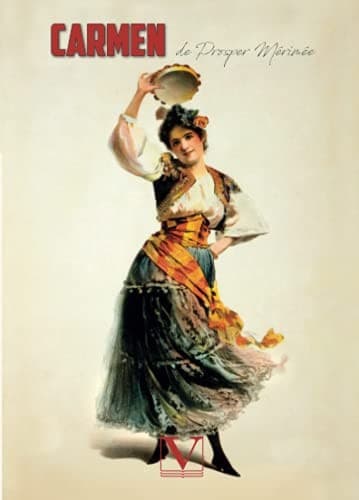
Carmen (Fictitious character) -- Fiction; Spain -- Social life and customs -- 19th century -- Fiction
“I was born,” he said, “at Elizondo, in the valley of Baztan. My name is
Don Jose Lizzarrabengoa, and you know enough of Spain, sir, to know at
once, by my name, that I come of an old Christian and Basque stock. I
call myself Don, because I have a right to it, and if I were at Elizondo
I could show you my parchment genealogy. My family wanted me to go into
the church, and made me study for it, but I did not like work. I was too
fond of playing tennis, and that was my ruin. When we Navarrese begin
to play tennis, we forget everything else. One day, when I had won the
game, a young fellow from Alava picked a quarrel with me. We took to our
_maquilas_,* and I won again. But I had to leave the neighbourhood.
I fell in with some dragoons, and enlisted in the Almanza Cavalry
Regiment. Mountain folks like us soon learn to be soldiers. Before long
I was a corporal, and I had been told I should soon be made a sergeant,
when, to my misfortune, I was put on guard at the Seville Tobacco
Factory. If you have been to Seville you have seen the great building,
just outside the ramparts, close to the Guadalquivir; I can fancy I see
the entrance, and the guard room just beside it, even now. When Spanish
soldiers are on duty, they either play cards or go to sleep. I, like an
honest Navarrese, always tried to keep myself busy. I was making a chain
to hold my priming-pin, out of a bit of wire: all at once, my comrades
said, ‘there’s the bell ringing, the girls are coming back to work.’ You
must know, sir, that there are quite four or five hundred women employed
in the factory. They roll the cigars in a great room into which no man
can go without a permit from the _Veintiquatro_,** because when the
weather is hot they make themselves at home, especially the young ones.
When the work-girls come back after their dinner, numbers of young men
go down to see them pass by, and talk all sorts of nonsense to them.
Very few of those young ladies will refuse a silk mantilla, and men who
care for that sort of sport have nothing to do but bend down and pick
their fish up. While the others watched the girls go by, I stayed on my
bench near the door. I was a young fellow then--my heart was still in
my own country, and I didn’t believe in any pretty girls who hadn’t
blue skirts and long plaits of hair falling on their shoulders.*** And
besides, I was rather afraid of the Andalusian women. I had not got used
to their ways yet; they were always jeering one--never spoke a single
word of sense. So I was sitting with my nose down upon my chain, when I
heard some bystanders say, ‘Here comes the _gitanella_!’ Then I lifted
up my eyes, and I saw her! It was that very Carmen you know, and in
whose rooms I met you a few months ago.
* Iron-shod sticks used by the Basques.
** Magistrate in charge of the municipal police
arrangements, and local government regulations.
*** The costume usually worn by peasant women in Navarre and
the Basque Provinces.
Public-domain text, read in full here on John Shaqi.
Reviews
Reviews
No reviews yet
Be the first to share your thoughts on this work.
Join the Discussion
Join the discussion
Sign in to leave a comment or review.
Sign InorCreate an account