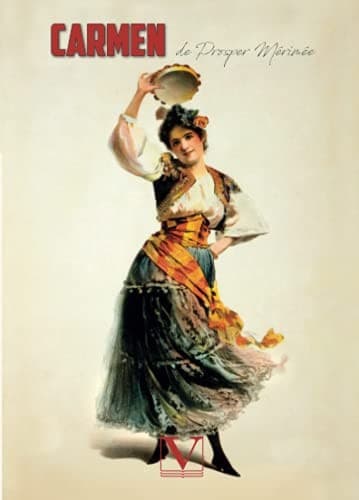
Carmen (Fictitious character) -- Fiction; Spain -- Social life and customs -- 19th century -- Fiction
“Two or three hours later I was still thinking about her, when a
panting, terrified-looking porter rushed into the guard-room. He told
us a woman had been stabbed in the great cigar-room, and that the guard
must be sent in at once. The sergeant told me to take two men, and go
and see to it. I took my two men and went upstairs. Imagine, sir, that
when I got into the room, I found, to begin with, some three hundred
women, stripped to their shifts, or very near it, all of them screaming
and yelling and gesticulating, and making such a row that you couldn’t
have heard God’s own thunder. On one side of the room one of the women
was lying on the broad of her back, streaming with blood, with an X
newly cut on her face by two strokes of a knife. Opposite the wounded
woman, whom the best-natured of the band were attending, I saw Carmen,
held by five or six of her comrades. The wounded woman was crying out,
‘A confessor, a confessor! I’m killed!’ Carmen said nothing at all. She
clinched her teeth and rolled her eyes like a chameleon. ‘What’s this?’
I asked. I had hard work to find out what had happened, for all the
work-girls talked at once. It appeared that the injured girl had boasted
she had money enough in her pocket to buy a donkey at the Triana Market.
‘Why,’ said Carmen, who had a tongue of her own, ‘can’t you do with a
broom?’ Stung by this taunt, it may be because she felt herself rather
unsound in that particular, the other girl replied that she knew nothing
about brooms, seeing she had not the honour of being either a gipsy
or one of the devil’s godchildren, but that the Senorita Carmen would
shortly make acquaintance with her donkey, when the _Corregidor_ took
her out riding with two lackeys behind her to keep the flies off.
‘Well,’ retorted Carmen, ‘I’ll make troughs for the flies to drink
out of on your cheeks, and I’ll paint a draught-board on them!’ * And
thereupon, slap, bank! She began making St. Andrew’s crosses on the
girl’s face with a knife she had been using for cutting off the ends of
the cigars.
* _Pintar un javeque_, “paint a xebec,” a particular type of
ship. Most Spanish vessels of this description have a
checkered red and white stripe painted around them.
Public-domain text, read in full here on John Shaqi.
Reviews
Reviews
No reviews yet
Be the first to share your thoughts on this work.
Join the Discussion
Join the discussion
Sign in to leave a comment or review.
Sign InorCreate an account