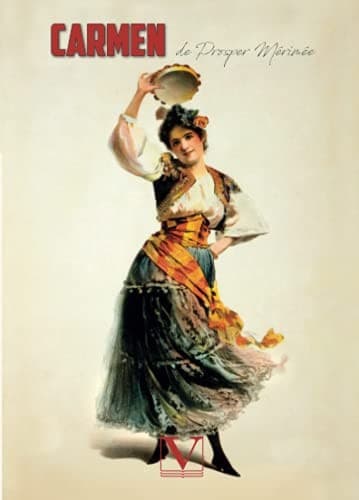
Carmen (Fictitious character) -- Fiction; Spain -- Social life and customs -- 19th century -- Fiction
“When I tried to cut it, my knife struck on something hard. I looked,
and found a little English file, which had been slipped into the dough
before the roll had been baked. The roll also contained a gold piece of
two piastres. Then I had no further doubt--it was a present from Carmen.
To people of her blood, liberty is everything, and they would set a
town on fire to save themselves one day in prison. The girl was artful,
indeed, and armed with that roll, I might have snapped my fingers at the
jailers. In one hour, with that little file, I could have sawn through
the thickest bar, and with the gold coin I could have exchanged my
soldier’s cloak for civilian garb at the nearest shop. You may fancy
that a man who has often taken the eaglets out of their nests in our
cliff would have found no difficulty in getting down to the street
out of a window less than thirty feet above it. But I didn’t choose to
escape. I still had a soldier’s code of honour, and desertion appeared
to me in the light of a heinous crime. Yet this proof of remembrance
touched me. When a man is in prison he likes to think he has a friend
outside who takes an interest in him. The gold coin did rather offend
me; I should have very much liked to return it; but where was I to find
my creditor? That did not seem a very easy task.
“After the ceremony of my degradation I had fancied my sufferings were
over, but I had another humiliation before me. That came when I left
prison, and was told off for duty, and put on sentry, as a private
soldier. You can not conceive what a proud man endures at such a moment.
I believe I would have just as soon been shot dead--then I should have
marched alone at the head of my platoon, at all events; I should have
felt I was somebody, with the eyes of others fixed upon me.
“I was posted as sentry on the door of the colonel’s house. The colonel
was a young man, rich, good-natured, fond of amusing himself. All
the young officers were there, and many civilians as well, besides
ladies--actresses, as it was said. For my part, it seemed to me as if
the whole town had agreed to meet at that door, in order to stare at me.
Then up drove the colonel’s carriage, with his valet on the box. And who
should I see get out of it, but the gipsy girl! She was dressed up, this
time, to the eyes, togged out in golden ribbons--a spangled gown, blue
shoes, all spangled too, flowers and gold lace all over her. In her hand
she carried a tambourine. With her there were two other gipsy women, one
young and one old. They always have one old woman who goes with them,
and then an old man with a guitar, a gipsy too, to play alone, and also
for their dances. You must know these gipsy girls are often sent for to
private houses, to dance their special dance, the _Romalis_, and often,
too, for quite other purposes.
“Carmen recognised me, and we exchanged glances. I don’t know why, but
at that moment I should have liked to have been a hundred feet beneath
the ground.
Public-domain text, read in full here on John Shaqi.
Reviews
Reviews
No reviews yet
Be the first to share your thoughts on this work.
Join the Discussion
Join the discussion
Sign in to leave a comment or review.
Sign InorCreate an account