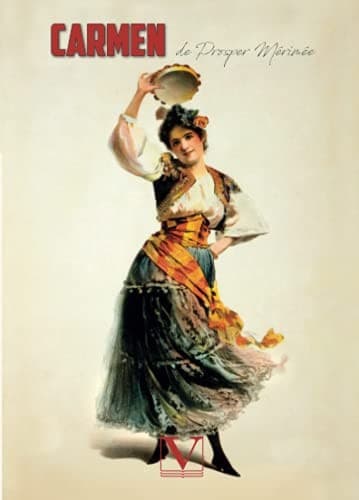
Carmen (Fictitious character) -- Fiction; Spain -- Social life and customs -- 19th century -- Fiction
One remarkable feature in the gipsy character is their indifference
about religion. Not that they are strong-minded or sceptical. They
have never made any profession of atheism. Far from that, indeed, the
religion of the country which they inhabit is always theirs; but they
change their religion when they change the country of their residence.
They are equally free from the superstitions which replace religious
feeling in the minds of the vulgar. How, indeed, can superstition exist
among a race which, as a rule, makes its livelihood out of the credulity
of others? Nevertheless, I have remarked a particular horror of touching
a corpse among the Spanish gipsies. Very few of these could be induced
to carry a dead man to his grave, even if they were paid for it.
I have said that most gipsy women undertake to tell fortunes. They do
this very successfully. But they find a much greater source of profit
in the sale of charms and love-philters. Not only do they supply toads’
claws to hold fickle hearts, and powdered loadstone to kindle love in
cold ones, but if necessity arises, they can use mighty incantations,
which force the devil to lend them his aid. Last year the following
story was related to me by a Spanish lady. She was walking one day along
the _Calle d’Alcala_, feeling very sad and anxious. A gipsy woman who
was squatting on the pavement called out to her, “My pretty lady, your
lover has played you false!” (It was quite true.) “Shall I get him
back for you?” My readers will imagine with what joy the proposal was
accepted, and how complete was the confidence inspired by a person who
could thus guess the inmost secrets of the heart. As it would have been
impossible to proceed to perform the operations of magic in the most
crowded street in Madrid, a meeting was arranged for the next day.
“Nothing will be easier than to bring back the faithless one to your
feet!” said the gitana. “Do you happen to have a handkerchief, a scarf,
or a mantilla, that he gave you?” A silken scarf was handed her. “Now
sew a piastre into one corner of the scarf with crimson silk--sew half
a piastre into another corner--sew a peseta here--and a two-real piece
there; then, in the middle you must sew a gold coin--a doubloon would be
best.” The doubloon and all the other coins were duly sewn in. “Now give
me the scarf, and I’ll take it to the Campo Santo when midnight strikes.
You come along with me, if you want to see a fine piece of witchcraft.
I promise you shall see the man you love to-morrow!” The gipsy departed
alone for the Campo Santo, since my Spanish friend was too much afraid
of witchcraft to go there with her. I leave my readers to guess whether
my poor forsaken lady ever saw her lover, or her scarf, again.
Public-domain text, read in full here on John Shaqi.
Reviews
Reviews
No reviews yet
Be the first to share your thoughts on this work.
Join the Discussion
Join the discussion
Sign in to leave a comment or review.
Sign InorCreate an account