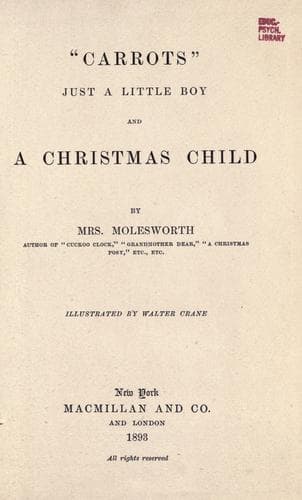
Boys -- Juvenile fiction; Children's stories; Families -- Juvenile fiction
He told his mother about his thinking perhaps the fairies had brought
the "sixpenny," and she explained to him that now-a-days, alas! that was
hardly likely to be the case, though she seemed quite to understand his
fancying it, and did not laugh at him at all. But she spoke very gravely
to him, too, about _never_ taking anything that was not his; and after
listening and thinking with all his might, Carrots said he thought he
"kite under'tood."
"I am never, never to take nucken that I'm not sure is mine," he said
slowly. "And if ever I'm not sure I'm to ask somebody, you, or nursie,
or Floss--or _sometimes_, perhaps, Cecil. But I don't think I'd better
ask Mott, for perhaps he wouldn't under'tand."
But Mott's mother took care that before the day was over Mott _should_
"under'tand" something of where and how he had been in fault; that there
are sometimes ways of doing _right_ which turn it into "wrong;" and that
want of pity and tenderness for the wrong _doer_ never, never can be
right.
CHAPTER VII.
A LONG AGO STORY.
"You may laugh, my little people,
But be sure my story's true;
For I vow by yon church steeple,
I was once a child like you."
_The Land of Long Ago._
If any of you children have travelled much, have you noticed that on a
long journey there seem to come points, turns--I hardly know what to
call them--after which the journey seems to go on differently. More
quickly, perhaps more cheerfully, or possibly less so, but certainly
_differently_. Looking back afterwards you see it was so--"from the time
we all looked out of the window at the ruined abbey we seemed to get on
so much faster," you would say, or--"after the steamer had passed the
Spearhead Point, we began to feel dull and tired, and there was no more
sunshine."
I think it is so in life. Suddenly, often quite unknowingly, we turn a
corner sometimes of our history, sometimes of our characters, and
looking back, long afterwards, we make a date of that point. It was so
just now with my little Carrots. This trouble of his about the
half-sovereign changed him. I do not mean to say that it saddened him
and made him less happy than he had been--at his age, thank God, few, if
any children have it in them to be so deeply affected--but it _changed_
him. It was his first peep out into life, and it gave him his first real
_thoughts_ about things. It made him see how a little wrong-doing may
cause great sorrow; it gave him his first vague, misty glimpse of that,
to my thinking, saddest of all sad things--the way in which it is
possible for our very nearest and dearest to mistake and misunderstand
us.
Public-domain text, read in full here on John Shaqi.
Reviews
Reviews
No reviews yet
Be the first to share your thoughts on this work.
Join the Discussion
Join the discussion
Sign in to leave a comment or review.
Sign InorCreate an account