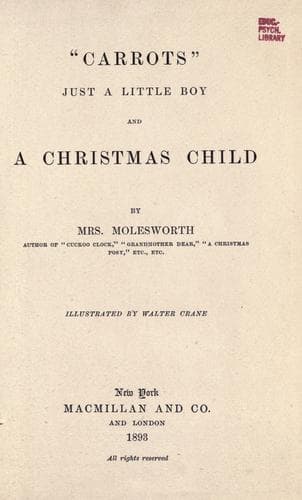
Boys -- Juvenile fiction; Children's stories; Families -- Juvenile fiction
They all laughed, but there was still a little sigh at the bottom of
auntie's heart. There was reason for it greater than the sight of her
little nephew's and niece's shabby clothes.
But there was no sigh in the hearts of Floss and Carrots.
"Carrots," said Floss, as they made their way to the nursery to decide
which of their small collection of toys were fit for Sybil's inspection,
"Carrots, _did_ you hear."
"What auntie said?" asked Carrots. "Yes, I heard. Do you think mamma
will ever let us go?"
"Some day, perhaps," said Floss, and oh what dreams and plans and
fancies hung on that "perhaps!" "_Fancy_, Carrots, we should go in the
railway, you and me, Carrots, alone perhaps."
"Oh, Floss!" said Carrots, his feelings being beyond further expression.
That "some day" was a good way off, however, but "to-day" was here, and
a nice bright-looking to-day it was. How happy they were! How happy
Sybil was!
For, somehow, though she was dressed like a princess, though since
babyhood she had had _everything_ a child could wish for, though very
often, I must confess, she had had "her own way," a good deal more than
would have been good for most children, little Sybil was not spoilt. The
spoiling dropped off her like water down a duck's back, and auntie never
found out it had been there at all! Perhaps after all there is a kind of
spoiling that isn't spoiling--love and kindness, and even indulgence, do
not spoil when there is perfect trust and openness, and when a child at
the same time is taught the one great lesson, that the best happiness is
trying to make others happy too.
They played on the sands nearly all day, and Sybil, to her great
delight, was covered up from damage by one of Carrots' blouses. The sun
came out bright and warm, and they built the most lovely sand house you
ever saw.
"I'd like to live in it always," said Carrots.
"Oh you funny boy," said Sybil patronisingly, "and what would you do at
night, when it got cold, and perhaps the sea would come in."
"Perhaps the mermaids would take care of him till the morning," said
Floss.
"What are the mermaids?" asked Sybil.
"Pretty ladies," said Carrots, "who live at the bottom of the sea, only
they've got tails."
"Then they can't be pretty," said Sybil decidedly, "not unless their
tails are beautiful and sweeping out, like peacocks! Are they?--one day
I tied a shawl of mother's on, it was a red and gold shawl, and I
sweeped it about just like a peacock,--that _would_ be pretty."
"I don't think mermaids' tails are like that," said Carrots, doubtfully,
"but they _are_ pretty ladies, aren't they, Floss?"
"Beautiful," said Floss, "but they're very sad. They come up to the
shore at night and comb their hair and cry dreadfully."
"What do they cry for?" asked Sybil and Carrots, pressing up to Floss,
and forgetting all about the lovely sand house.
"Because they--no, you couldn't understand," she broke off; "it is no
good telling you."
"Oh do tell," said the children.
Public-domain text, read in full here on John Shaqi.
Reviews
Reviews
No reviews yet
Be the first to share your thoughts on this work.
Join the Discussion
Join the discussion
Sign in to leave a comment or review.
Sign InorCreate an account