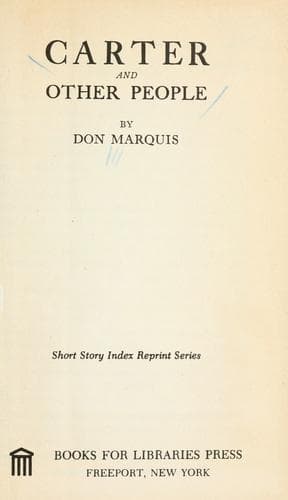
American fiction -- 20th century; Short stories, American
And, patiently, McDermott studied the mechanism, while the red sunlight
turned to yellow in the Grande Place outside, and the budding green
vines withered along the broken walls, and the stones ran blood, and the
Hôtel Fauçon began to fall to pieces about his ears. McDermott did not
hurry; he felt that there was no need to hurry; he had not yet made up
his mind whether he intended to participate in this war. By the time he
had learned how to work that machine gun, and had used it on the Germans
for a while, he thought, he might be vouchsafed some light on that
particular subject. It was one of McDermott's fixed beliefs that he
was an extremely cautious sort of man, though many of his acquaintances
thought of him differently, and he told himself that he must not get too
far into this war until he was sure that it was going to be congenial.
So far, it promised well.
And also, McDermott, as he puzzled over the machine gun, was not quite
the normal McDermott. He was, rather, a supernormal McDermott. He had
been awakened rudely from an alcoholic slumber and he had been rather
busy ever since; so many things had taken place in his immediate
neighborhood, and were still taking place, that he was not quite sure
of their reality. As he sat on the floor and studied the weapon, he was
actually, from moment to moment, more than half convinced that he was
dreaming--he might awaken and find that that war had eluded him again.
Perhaps he is scarcely to be chided for being in what is sometimes known
as a state of mind.
And while McDermott was looking at the machine gun, the British
commander prayed, as a greater British commander before him had prayed
one time, for assistance, only this one did not pray for night or
Blucher as Wellington had done. Night was many hours beyond all
hope and would probably bring its own hell when it came, and as for
Prussians, there were too many Prussians now. His men would hold on;
they had been holding on for epic days and unbelievable nights, and they
would still hold while there was breath in their bodies, and when their
bodies were breathless they would hold one minute more. But--God! For
Foch's _poilus!_ There is a moment which is the ultimate moment; the
spirit can drag the body until--until spirit and body are wrenched into
two things. No longer. His men could die in their tracks; they were
dying where they stood and crouched and lay, by dozens and by scores and
by heroic hundreds--but when they were dead, who would bar the way to
Hazebrouck, and beyond Hazebrouck, to the channel ports?
Public-domain text, read in full here on John Shaqi.
Reviews
Reviews
No reviews yet
Be the first to share your thoughts on this work.
Join the Discussion
Join the discussion
Sign in to leave a comment or review.
Sign InorCreate an account