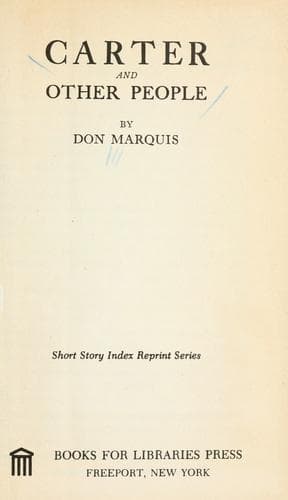
American fiction -- 20th century; Short stories, American
The man made no sound, but he, too, drew back a step, not seeming to see
Looney's outstretched hand.
But he did see it--he saw more than that. He saw, as if they were
flashed before him at lightning speed upon a cinema screen, a dozen
scenes of a wild and reckless and indigent youth that he had thought was
dead forever; he saw these roughneck years suddenly leap alive and
stalk toward him again, toward him and his; he saw his later years of
industry, his hard-won success, his position so strenuously battled for,
his respectability that was become so dear to him, all his house of
life so laboriously builded, crumbling before the touch of this torn and
grotesque outcast that confronted and claimed him, this wavering,
dusty lunatic whom he dimly remembered. If his wife knew--if her people
knew--if the business men of this town were to know----
He shuddered and turned sick, and then with a sudden recovery he took
his child from its mother and guided her before him into the waiting
room.
Looney watched them enter, in silence. He stood dazed for a moment,
and then he slowly turned and walked down the railroad track beyond the
limits of the town. There, upon a spot of turf beside the right of
way, he threw himself upon his face and sobbed and moaned, as a
broken-hearted child sobs, as a dog moans upon its master's grave.
But after a while he looked up. Slim's star was looking down at him, red
and confident and heartening as ever. He gazed at it a long time, and
then an idea took form in his ruined brain and he said aloud:
“Now, dat wasn't _really_ Slim! I been lookin' fer Slim so long I t'ink
I see Slim where he ain't! Dat was jus' some guy wot looks like Slimmy.
Slimmy, he wouldn't never of gone back on an old pal like dat!”
The rumble of an approaching train caught his ears. He got to his feet
and prepared to board it.
“Slim, he's waitin' fer me somewheres,” he told the star. “I may be
kinda looney about some t'ings, but I knows Slim, an' dey ain't no
yellow streak nowheres in Slim!”
And with unshaken loyalty Looney the Mutt boarded the train and set off
upon his endless quest anew.
VI--Kale
|See that old fellow there?” asked Ed the waiter. “Well, his fad is
money.”
The old fellow indicated--he must have been nearly eighty--sat eating
corned beef and cabbage in a little booth in a certain delightful,
greasy old chophouse in downtown New York. It was nearly time to close
the chophouse for that day for it was almost eleven o'clock at night; it
was nearly time to close the chophouse forever, for it was the middle of
June, 1919. In a couple of weeks the wartime prohibition act would be in
force, and Ed and I had been discussing what effect it would have upon
our respective lives.
There was no one else in the place at the time except the cashier and
the old man whose fad was money, and so Ed had condescended toward me,
as a faithful customer, and was sitting down to have a drink with me.
Public-domain text, read in full here on John Shaqi.
Reviews
Reviews
No reviews yet
Be the first to share your thoughts on this work.
Join the Discussion
Join the discussion
Sign in to leave a comment or review.
Sign InorCreate an account