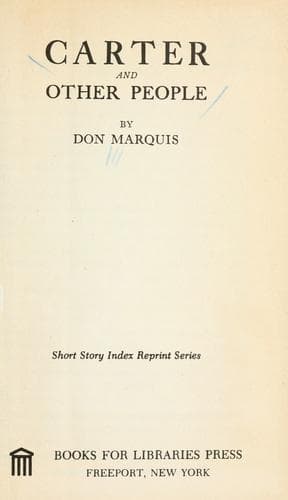
American fiction -- 20th century; Short stories, American
It was nearly midnight when Tommy and his friend Dobson returned to the
hotel. “Your paper's been trying to get you for an hour, Mr. Hawkins,”
said the night clerk when they came in. “Story right in the next room to
yours. Old party in there hanged himself.”
“So?” said Tommy. “Ungrateful old guy, he is! I put in the afternoon
trying to cheer him up a little.”
“Did you know him?” asked the clerk.
“Nope,” said Tommy, moving toward the elevator.
But a few moments later, confronted with the grotesque spectacle in the
room upstairs, he said, “Yes--I--I know him. Jack! Jack! Get me out of
here, Jack! It's Uncle Ezra, Jack! He's--he's come for me!”
As has been remarked before, sometimes even a bubble may be a mordant
weapon.
VIII.--The Chances of the Street
|Merriwether Buck had lost all his money. Also his sisters', and his
cousins', and his aunts'.
“At two o'clock sharp I will shoot myself,” said Merriwether Buck.
He caressed a ten-shot automatic pistol in the right-hand pocket of his
coat as he loitered up Broadway. He was light-headed. He had had nothing
to eat for forty-eight hours.
“How I hate you!” said Merriwether Buck, comprehensively to the city in
general. “If nine pistol shots would blot you out, I'd do it!”
Very melodramatic language, this, for a well-brought-up young man; and
thus indicating that he was light-headed, indeed. And as for the city,
it continued to roar and rattle and honk and rumble and squeak and bawl
and shuffle and thunder and grate in the same old way--supreme in its
confidence that nine pistol shots could not, by any possibility, blot
it out. That is one of the most disconcerting things about a city; you
become enraged at it, and the city doesn't even know it. Unless you
happen to be Nero it is very difficult to blot them out satisfactorily.
It was one o'clock. Merriwether Buck crossed the street at Herald Square
and went over and stood in front of the big newspaper office. A portly
young fellow with leaden eyes came out of the building and stood
meditatively on the curb with his hands in the pockets of clothing that
clamored shrilly of expense.
“Excuse me,” said Merriwether Buck, approaching him, “but are you, by
any chance, a reporter?”
“Uh,” grunted the young man, frigidly affirmative.
“I can put you in the way of a good story,” said Merriwether Buck,
obeying an impulse: We may live anonymously but most of us like to feel
that it will make a little stir when we die.
“Huh,” remarked the reporter.
“At two o'clock,” persisted Merriwether Buck, “I am going to shoot
myself.”
The reporter looked bored; his specialty was politics.
“Are you anybody in particular?” he asked, discouragingly.
“No,” confessed Merriwether Buck. It didn't seem to be worth while to
mention that he was one of the Bucks of Bucktown, Merriwether County,
Georgia.
“I thought,” said the reporter, with an air of rebuke, “that you said it
was a _good_ story.”
Public-domain text, read in full here on John Shaqi.
Reviews
Reviews
No reviews yet
Be the first to share your thoughts on this work.
Elsewhere in the archive
Join the Discussion
Join the discussion
Sign in to leave a comment or review.
Sign InorCreate an account