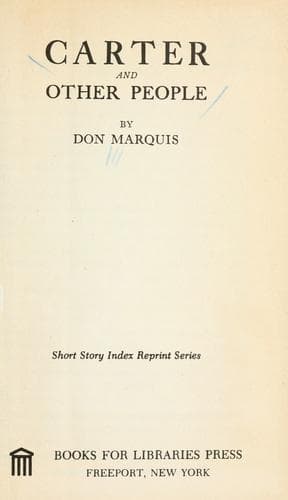
American fiction -- 20th century; Short stories, American
“I am, at least, a human being,” said Merriwether Buck, on the
defensive.
“They're cheap, hereabout,” returned the other, in the manner of a
person who has estimated a good many assorted lots.
“You are callous,” said Merriwether Buck. “Callous to the soul! What are
you, but--but--Why, you are New York incarnate! That is what you are!
And I think I will shoot you first!”
“I don't want to be a spoil sport,” said the reporter, “but I'm afraid I
can't allow it. I have a rather important assignment.”
Merriwether played with the little automatic pistol in his pocket. It
was not any regard for the consequences that deterred him from shooting
the portly young man. But in his somewhat dizzy brain a fancy was taking
shape; a whim worked in him. He drew his hand empty from the pocket, and
that reporter came up out of the grave.
“I am hungry,” said Merriwether Buck, in obedience to the whim.
“Now that you remind me of it,” said the other, his lack-luster
eyes lighting up a little, “so am I!” And he crossed the street and
disappeared through the swinging doors of a café.
Callous, leaden-eyed young man! epitome of this hard town! So cried the
spirit of Merriwether Buck; and then he spoke aloud, formulating his
idea:
“New York, you are on trial. You are in the balances. I give you an
hour. If I'm asked to lunch by two o'clock, all right. If not, I will
kill myself, first carefully shooting down the most prosperous citizens,
and as many of 'em as I can reach. New York, it's up to you!”
The idea of playing it out that way tickled him to the heart; he had
always loved games of chance. One man or woman out of all the prosperous
thousands in the streets might save another prosperous half-dozen;
might save as many as he could otherwise reach with nine shots from his
pistol, for he would reserve the tenth for himself. Otherwise, there
should be a sacrifice; he would offer up a blood atonement for the pagan
city's selfishness. Giddy and feverish, and drunk with the sense of his
power to slay, he beheld himself as a kind of grotesque priest--and he
threw back his head and laughed at the maniac conceit.
A woman who was passing turned at the sound, and their eyes met. She
smiled. Merriwether Buck was good to look at. So was she. She was of
that type of which men are certain at once, without quite knowing why;
while women are often puzzled, saying to themselves: “After all, it may
be only her rings.”
“Pardon me,” said Merriwether Buck, overtaking her, “but you and I are
to lunch together, aren't we?”
“I like your nerve!” said she. And she laughed. It was evident that she
did like it. “Where?” she asked briefly, falling into step beside him.
“Wherever you like,” said Merriwether. “I leave that to you, as I'm
depending on you to pay the check.”
She began a doubtful laugh, and then, seeing that it wasn't a joke,
repeated:
“I like your nerve!” And it was now evident that she didn't like it.
Public-domain text, read in full here on John Shaqi.
Reviews
Reviews
No reviews yet
Be the first to share your thoughts on this work.
Elsewhere in the archive
Join the Discussion
Join the discussion
Sign in to leave a comment or review.
Sign InorCreate an account