Adventure stories; Biographical fiction; Casanova, Giacomo, 1725-1798 -- Fiction; Europe -- Fiction; Sex customs -- Fiction
Produced by Juliet Sutherland, David Widger and PG
Distributed Proofreaders
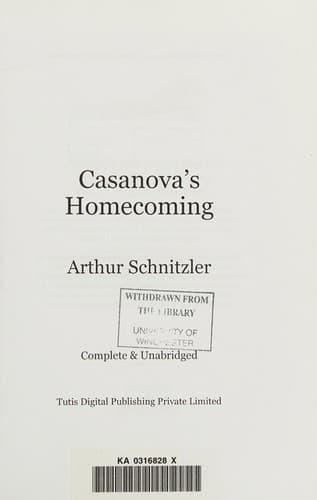
CASANOVA’S HOMECOMING
By Arthur Schnitzler
1922
The Translation of this book was made by EDEN AND CEDAR PAUL
CHAPTER ONE.
Casanova was in his fifty-third year. Though no longer driven by the
lust of adventure that had spurred him in his youth, he was still hunted
athwart the world, hunted now by a restlessness due to the approach of
old age. His yearning for Venice, the city of his birth, grew so intense
that, like a wounded bird slowly circling downwards in its death flight,
he began to move in ever-narrowing circles. Again and again, during the
last ten years of his exile, he had implored the Supreme Council for
leave to return home. Erstwhile, in the drafting of these petitions--a
work in which he was a past master--a defiant, wilful spirit seemed to
have guided his pen; at times even he appeared to take a grim delight in
his forwardness. But of late his requests had been couched in humble,
beseeching words which displayed, ever more plainly, the ache of
homesickness and genuine repentance.
The sins of his earlier years (the most unpardonable to the Venetian
councillors was his free-thinking, not his dissoluteness, or
quarrelsomeness, or rather sportive knavery) were by degrees passing
into oblivion, and so Casanova had a certain amount of confidence that
he would receive a hearing. The history of his marvellous escape from
The Leads of Venice, which he had recounted on innumerable occasions at
the courts of princes, in the palaces of nobles, at the supper tables of
burghers, and in houses of ill fame, was beginning to make people forget
any disrepute which had attached to his name. Moreover, in letters to
Mantua, where he had been staying for two months, persons of influence
had conveyed hope to the adventurer, whose inward and outward lustre
were gradually beginning to fade, that ere long there would come a
favorable turn in his fortunes.
Since his means were now extremely slender, Casanova had decided to
await the expected pardon in the modest but respectable inn where he had
stayed in happier years. To make only passing mention of less spiritual
amusements, with which he could not wholly dispense--he spent most of
his time in writing a polemic against the slanderer Voltaire, hoping
that the publication of this document would serve, upon his return to
Venice, to give him unchallenged position and prestige in the eyes of
all well-disposed citizens.
Public-domain text, read in full here on John Shaqi.
Reviews
Reviews
No reviews yet
Be the first to share your thoughts on this work.
Join the Discussion
Join the discussion
Sign in to leave a comment or review.
Sign InorCreate an account