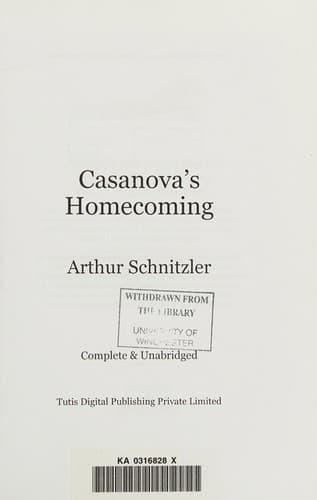
Adventure stories; Biographical fiction; Casanova, Giacomo, 1725-1798 -- Fiction; Europe -- Fiction; Sex customs -- Fiction
“I hope, Marcolina,” said Lorenzi, speaking to her for the first time,
“that you will not attempt to imitate the noble abbess in other respects
as well as learning.”
“Why should I?” rejoined Marcolina serenely. “We can maintain our
freedom without vows. Better without than with, for a vow is a form of
coercion.”
Casanova was sitting next to her. He did not dare to let his foot touch
hers lightly, or to press his knee against hers. He was certain that
should she for the third time look at him with that expression of horror
and loathing, he would be driven to some act of folly. As the meal
progressed, as the number of emptied glasses grew and the conversation
waxed livelier and more general, Casanova heard, once more as from afar,
Amalia’s voice.
“I have spoken to Marcolina.”
“You have spoken to her?” A mad hope flamed up in him. “Calm yourself,
Casanova. We did not speak of you, but only of her and her plans for the
future. I say to you again, she will never give herself to any man.”
Olivo, who had been drinking freely, suddenly rose, glass in hand, and
delivered himself of a few stumbling phrases concerning the great honor
conferred upon his humble home by the visit of his dear friend, the
Chevalier de Seingalt.
“But where, my dear Olivo, is the Chevalier de Seingalt of whom you
speak?” enquired Lorenzi in his clear, insolent voice.
Casanova’s first impulse was to throw the contents of his glass in
Lorenzi’s face.
Amalia touched his arm lightly, to restrain him, and said: “Many people
to-day, Chevalier, still know you best by the old and more widely
renowned name of Casanova.”
“I was not aware,” said Lorenzi, with offensive gravity, “that the King
of France had ennobled Signor Casanova.”
“I was able to save the King that trouble,” answered Casanova quietly.
“I trust, Lieutenant Lorenzi, that you will be satisfied with an
explanation to which the Burgomaster of Nuremberg offered no objection
when I gave it to him in circumstances with which I need not weary the
company.” There was a moment of silent expectation. Casanova continued:
“The alphabet is our common heritage. I chose a collocation of letters
which pleased my taste, and ennobled myself without being indebted to
any prince, who might perhaps have been disinclined to allow my claim.
I style myself Casanova, Chevalier de Seingalt. I am indeed sorry,
Lieutenant Lorenzi, if this name fails to meet with your approval.”
“Seingalt! It is a splendid name,” said the Abbate, repeating it several
times, as if he were tasting it.
“There is not a man in the world,” exclaimed Olivo, “who has a better
right to name himself Chevalier than my distinguished friend Casanova!”
“As for you, Lorenzi,” added the Marchese, “when your reputation has
reached as far as that of Signor Casanova, Chevalier de Seingalt, we
shall be willing enough, should you so desire, to give you also the
title of Chevalier.”
Public-domain text, read in full here on John Shaqi.
Reviews
Reviews
No reviews yet
Be the first to share your thoughts on this work.
Join the Discussion
Join the discussion
Sign in to leave a comment or review.
Sign InorCreate an account