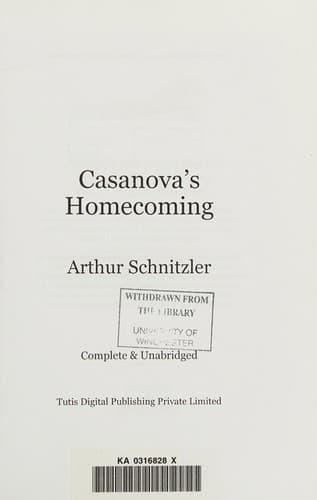
Adventure stories; Biographical fiction; Casanova, Giacomo, 1725-1798 -- Fiction; Europe -- Fiction; Sex customs -- Fiction
When they had gone, Olivo took Casanova by the arm, and assured his
guest repeatedly, with tears in his voice, that everything in the house
was at Casanova’s absolute disposal. They walked past Marcolina’s
window. Not merely was the window closed, but the iron grating had
been fastened; within, the window was curtained. There had been times,
thought Casanova, when all these precautions had been unavailing, or had
been without significance. They reëntered the house. Olivo would not be
dissuaded from accompanying the guest up the creaking staircase into the
turret chamber. He embraced Casanova as he bade him good-night.
“To-morrow,” he said, “you shall see the nunnery. But sleep as late as
you please. We are not early risers here; anyhow we shall adapt the
hours to your convenience. Good-night!” He closed the door quietly, but
his heavy tread resounded through the house.
CHAPTER FOUR.
The room in which Casanova was now left to his own devices was dimly
lighted by two candles. His gaze roamed successively to the four
windows, looking to the four quarters of heaven. The prospect was much
the same from them all. The landscape had a bluish sheen. He saw broad
plains with no more than trifling elevations, except to the northward
where the mountains were faintly visible. A few isolated houses, farms,
and larger buildings, could be made out. Among these latter was one
which stood higher than the rest. Here there was still a light in one of
the windows, and Casanova imagined it must be the Marchese’s mansion.
The furniture of the room was simple. The double bed stood straight out
into the room. The two candles were on a long table. There were a few
chairs, and a chest of drawers bearing a gilt-framed mirror. Everything
was in perfect order, and the valise had been unpacked. On the table,
locked, lay the shabby portfolio containing Casanova’s papers. There
were also some books which he was using in his work; writing materials
had been provided.
He did not feel sleepy. Taking his manuscript out of the portfolio, he
reread what he had last written. Since he had broken off in the middle
of a sentence, it was easy for him to continue. He took up the pen,
wrote a phrase or two, then paused.
“To what purpose?” he demanded of himself, as if in a cruel flash of
inner illumination. “Even if I knew that what I am writing, what I am
going to write, would be considered incomparably fine; even if I could
really succeed in annihilating Voltaire, and in making my renown greater
than his--would I not gladly commit these papers to the flames could I
but have Marcolina in my arms? For that boon, should I not be willing to
vow never to set foot in Venice again, even though the Venetians should
wish to escort me back to the city in triumph?”
Public-domain text, read in full here on John Shaqi.
Reviews
Reviews
No reviews yet
Be the first to share your thoughts on this work.
Join the Discussion
Join the discussion
Sign in to leave a comment or review.
Sign InorCreate an account