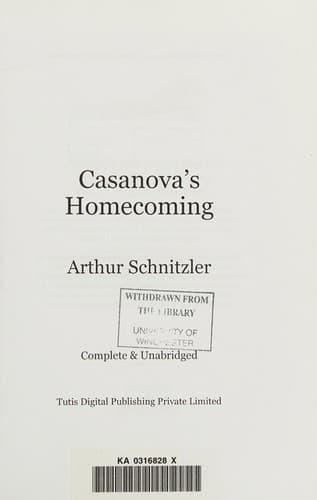
Adventure stories; Biographical fiction; Casanova, Giacomo, 1725-1798 -- Fiction; Europe -- Fiction; Sex customs -- Fiction
“Why,” he asked himself, “did I not go to the window while it was still
open? Why did I not leap over the sill? Could she have offered any
resistance; would she have dared to do so; hypocrite, liar, strumpet?”
He continued to rail at her as though he had a right to do so, as though
he had been her lover to whom she had plighted troth and whom she had
betrayed. He swore to question her face to face; to denounce her before
Olivo, Amalia, the Marchese, the Abbate, the servants, as nothing better
than a lustful little whore. As if for practice, he recounted to himself
in detail what he had just witnessed, delighting in the invention of
incidents which would degrade her yet further. He would say that she had
stood naked at the window; that she had permitted the unchaste caresses
of her lover while the morning wind played upon them both.
After thus allaying the first vehemence of his anger, he turned
to consider whether he might not make a better use of his present
knowledge. Was she not in his power? Could he not now exact by threats
the favors which she had not been willing to grant him for love? But
this infamous design was speedily abandoned; not so much because
Casanova realized its infamy, as because, even while the plan crossed
his mind, he was aware of its futility. Why should Marcolina,
accountable to no one but herself, be concerned at his threats? In the
last resort she was astute enough, if needs must, to have him driven
from the house as a slanderer and blackmailer. Even if, for one reason
or another, she were willing to give herself to him in order to preserve
the secret of her amours with Lorenzi (he was aware that he was
speculating on something beyond the bounds of possibility), a pleasure
thus extorted would become for him a nameless torment. Casanova
knew himself to be one whose rapture in a love relationship was a
thousandfold greater when conferring pleasure than when receiving it.
Such a victory as he was contemplating would drive him to frenzy and
despair.
Suddenly he found himself at the door in the garden wall. It was locked.
Then Lorenzi had a master-key! But who, it now occurred to him to ask,
had ridden the horse he had heard trotting away after Lorenzi had left
the card table? A servant in waiting for the purpose, obviously.
Involuntarily Casanova smiled his approval. They were worthy of one
another, these two, Marcolina and Lorenzi, the woman philosopher and the
officer. A splendid career lay before them.
“Who will be Marcolina’s next lover?” he thought questioningly. “The
professor in Bologna in whose house she lives? Fool, fool! That is
doubtless an old story. Who next? Olivo? The Abbate? Wherefore not? Or
the serving-lad who stood gaping at the door yesterday when we drove up?
She has given herself to all of them. I am sure of it. But Lorenzi does
not know. I have stolen a march on him there.”
Public-domain text, read in full here on John Shaqi.
Reviews
Reviews
No reviews yet
Be the first to share your thoughts on this work.
Join the Discussion
Join the discussion
Sign in to leave a comment or review.
Sign InorCreate an account