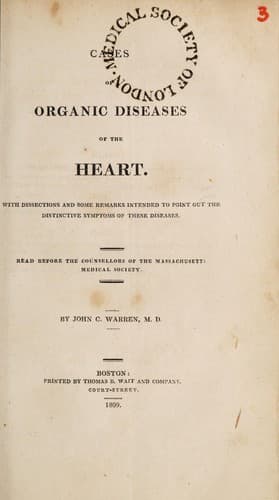
Cases of Organic Diseases of the Heart — John Shaqi
Cases of Organic Diseases of the HeartWarren, John Collins
Science
Cases of Organic Diseases of the Heart
Warren, John Collins
Heart -- Diseases
[Footnote 1: A careful examination of the works of some of
the most eminent English practical writers does not afford
evidence of any clear distinction of these diseases of the
heart. Dr. Cullen, whose authority is of the highest
estimation, evidently enumerates symptoms of them in his
definition and description of the hydrothorax. In § 1702 Th.
and Pr. he places much confidence on a particular sign of
water in the chest, and remarks, that the same sign is not
produced by the presence of pus. Now, there is no sufficient
reason, why this symptom should not arise from the presence
of pus, as well as from that of water; but it probably can
depend on neither of those alone. See Morgagni de causis et
sedibus morborum, Epist. 16. art. 11. The experienced
Heberden says in the chapter “De palpitatione cordis,” “Hic
affectus manifesta cognitione conjunctus est cum istis
morbis, qui existimantur _nervorum proprii esse_, quique
_sanguinis missione augentur_; hoc igitur remedium plerumque
omittendum est.”—“Ubi remediis locus est, ex sunt adhibenda,
quæ conveniunt _affectibus hypochondriacis_.”
Dr. Baillie’s knowledge of morbid anatomy has enabled him to
make nearer approaches to truth; yet it will probably be
found, when this subject shall be fully understood, that his
descriptions of the symptoms of diseases of the heart and of
hydrothorax are not quite accurate, and, that with respect to
the former, they are very imperfect.
Some of the French physicians have devoted much attention to
this subject; especially M. Corvisart, professor in the
hospital of La Charite, at Paris, from whose clinical
lectures is derived the most important information.]
CASE I.
The symptoms of organic disease of the heart are marked with
extraordinary clearness in the following case. The opportunity for
observing them was very favourable; and there was every incitement to
close observation, which could arise from the important and
interesting character of the patient. These advantages will justify an
uncommon minuteness in the detail of the case; especially, as the most
accurate knowledge of a complaint is obtained from a successive view
of its stages.
The late Governour of this commonwealth was endowed with most vigorous
powers of mind and body. At the age of sixteen he was attacked with
fits of epilepsy, which first arose from a sudden fright, received on
awaking from sleep in a field, and beholding a large snake erecting
its head over him. As he advanced in life they became more frequent,
and were excited by derangement of the functions of the stomach, often
by affections of the mind, by dreams, and even by the sight of the
reptile which first produced the convulsions.
Public-domain text, read in full here on John Shaqi.
Reviews
Reviews
No reviews yet
Be the first to share your thoughts on this work.
Join the Discussion
Join the discussion
Sign in to leave a comment or review.
Sign InorCreate an account