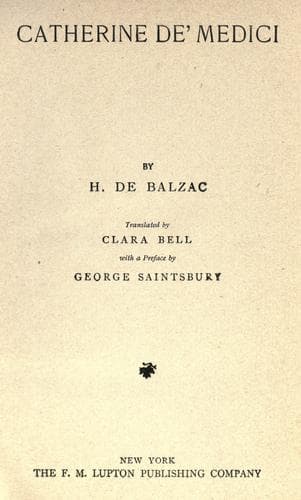
Catherine de Médicis, Queen, consort of Henry II, King of France, 1519-1589 -- Fiction; French fiction -- Translations into English
Chaudieu led Christophe to the water’s edge through an underground
passage, which was like that of the Marion tunnel filled up by the
authorities about ten years ago. This passage, which was situated
between the Lecamus house and the one adjoining it, ran under the rue
de la Vieille-Pelleterie, and was called the Pont-aux-Fourreurs. It was
used by the dyers of the City to go to the river and wash their flax and
silks, and other stuffs. A little boat was at the entrance of it, rowed
by a single sailor. In the bow was a man unknown to Christophe, a man of
low stature and very simply dressed. Chaudieu and Christophe entered the
boat, which in a moment was in the middle of the Seine; the sailor then
directed its course beneath one of the wooden arches of the pont au
Change, where he tied up quickly to an iron ring. As yet, no one had
said a word.
“Here we can speak without fear; there are no traitors or spies here,”
said Chaudieu, looking at the two as yet unnamed men. Then, turning an
ardent face to Christophe, “Are you,” he said, “full of that devotion
that should animate a martyr? Are you ready to endure all for our sacred
cause? Do you fear the tortures applied to the Councillor du Bourg, to
the king’s tailor,--tortures which await the majority of us?”
“I shall confess the gospel,” replied Lecamus, simply, looking at the
windows of his father’s back-shop.
The family lamp, standing on the table where his father was making up
his books for the day, spoke to him, no doubt, of the joys of family and
the peaceful existence which he now renounced. The vision was rapid, but
complete. His mind took in, at a glance, the burgher quarter full of its
own harmonies, where his happy childhood had been spent, where lived his
promised bride, Babette Lallier, where all things promised him a
sweet and full existence; he saw the past; he saw the future, and he
sacrificed it, or, at any rate, he staked it all. Such were the men of
that day.
“We need ask no more,” said the impetuous sailor; “we know him for one
of our _saints_. If the Scotchman had not done the deed he would kill us
that infamous Minard.”
“Yes,” said Lecamus, “my life belongs to the church; I shall give it
with joy for the triumph of the Reformation, on which I have seriously
reflected. I know that what we do is for the happiness of the peoples.
In two words: Popery drives to celibacy, the Reformation establishes the
family. It is time to rid France of her monks, to restore their lands to
the Crown, who will, sooner or later, sell them to the burghers. Let us
learn to die for our children, and make our families some day free and
prosperous.”
Public-domain text, read in full here on John Shaqi.
Reviews
Reviews
No reviews yet
Be the first to share your thoughts on this work.
Join the Discussion
Join the discussion
Sign in to leave a comment or review.
Sign InorCreate an account