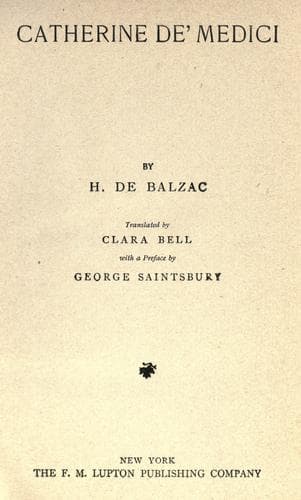
Catherine de Médicis, Queen, consort of Henry II, King of France, 1519-1589 -- Fiction; French fiction -- Translations into English
piquant face, with its pure lines, shone with the roguish mischief of
childhood, expressed in the regular eyebrows, the vivacious eyes, and
the archness of the pretty mouth. Already she displayed those feline
graces which nothing, not even captivity nor the sight of her dreadful
scaffold, could lessen. The two queens--one at the dawn, the other in
the midsummer of life--presented at this moment the utmost contrast.
Catherine was an imposing queen, an impenetrable widow, without other
passion than that of power. Mary was a light-hearted, careless
bride, making playthings of her triple crowns. One foreboded great
evils,--foreseeing the assassination of the Guises as the only means of
suppressing enemies who were resolved to rise above the Throne and the
Parliament; foreseeing also the bloodshed of a long and bitter struggle;
while the other little anticipated her own judicial murder. A sudden and
strange reflection calmed the mind of the Italian.
“That sorceress and Ruggiero both declare this reign is coming to an
end; my difficulties will not last long,” she thought.
And so, strangely enough, an occult science forgotten in our day--that
of astrology--supported Catherine at this moment, as it did, in fact,
throughout her life; for, as she witnessed the minute fulfilment of the
prophecies of those who practised the art, her belief in it steadily
increased.
“You are very gloomy, madame,” said Mary Stuart, taking from the hands
of her waiting-woman, Dayelle, a little cap and placing the point of it
on the parting of her hair, while two wings of rich lace surrounded the
tufts of blond curls which clustered on her temples.
The pencil of many painters have so frequently represented this
head-dress that it is thought to have belonged exclusively to Mary Queen
of Scots; whereas it was really invented by Catherine de’ Medici, when
she put on mourning for Henri II. But she never knew how to wear it
with the grace of her daughter-in-law, to whom it was becoming. This
annoyance was not the least among the many which the queen-mother
cherished against the young queen.
“Is the queen reproving me?” said Catherine, turning to Mary.
“I owe you all respect, and should not dare to do so,” said the Scottish
queen, maliciously, glancing at Dayelle.
Placed between the rival queens, the favorite waiting-woman stood rigid
as an andiron; a smile of comprehension might have cost her her life.
“Can I be as gay as you, after losing the late king, and now beholding
my son’s kingdom about to burst into flames?”
“Public affairs do not concern women,” said Mary Stuart. “Besides, my
uncles are there.”
These words were, under the circumstances, like so many poisoned arrows.
“Let us look at our furs, madame,” replied the Italian, sarcastically;
“that will employ us on our legitimate female affairs while your uncles
decide those of the kingdom.”
“Oh! but we will go the Council, madame; we shall be more useful than
you think.”
Public-domain text, read in full here on John Shaqi.
Reviews
Reviews
No reviews yet
Be the first to share your thoughts on this work.
Elsewhere in the archive
Join the Discussion
Join the discussion
Sign in to leave a comment or review.
Sign InorCreate an account