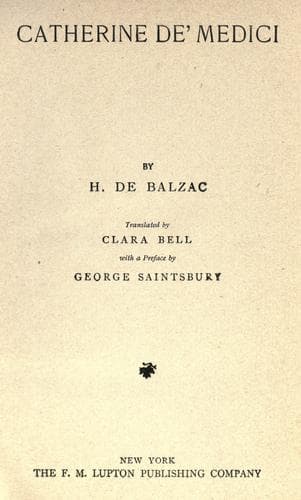
Catherine de Médicis, Queen, consort of Henry II, King of France, 1519-1589 -- Fiction; French fiction -- Translations into English
“We!” said Catherine, with an air of astonishment. “But I do not
understand Latin, myself.”
“You think me very learned,” cried Mary Stuart, laughing, “but I assure
you, madame, I study only to reach the level of the Medici, and learn
how to _cure_ the wounds of the kingdom.”
Catherine was silenced by this sharp thrust, which referred to the
origin of the Medici, who were descended, some said, from a doctor
of medicine, others from a rich druggist. She made no direct answer.
Dayelle colored as her mistress looked at her, asking for the applause
that even queens demand from their inferiors if there are no other
spectators.
“Your charming speeches, madame, will unfortunately cure the wounds of
neither Church nor State,” said Catherine at last, with her calm and
cold dignity. “The science of my fathers in that direction gave them
thrones; whereas if you continue to trifle in the midst of danger you
are liable to lose yours.”
It was at this moment that Ambroise Pare, the chief surgeon, scratched
softly on the door, and Madame Dayelle, opening it, admitted Christophe.
VII. A DRAMA IN A SURCOAT
The young reformer intended to study Catherine’s face, all the while
affecting a natural embarrassment at finding himself in such a place;
but his proceedings were much hastened by the eagerness with which the
younger queen darted to the cartons to see her surcoat.
“Madame,” said Christophe, addressing Catherine.
He turned his back on the other queen and on Dayelle, instantly
profiting by the attention the two women were eager to bestow upon the
furs to play a bold stroke.
“What do you want of me?” said Catherine giving him a searching look.
Christophe had put the treaty proposed by the Prince de Conde, the plan
of the Reformers, and the detail of their forces in his bosom between
his shirt and his cloth jacket, folding them, however, within the bill
which Catherine owed to the furrier.
“Madame,” he said, “my father is in horrible need of money, and if you
will deign to cast your eyes over your bill,” here he unfolded the paper
and put the treaty on the top of it, “you will see that your Majesty
owes him six thousand crowns. Have the goodness to take pity on us. See,
madame!” and he held the treaty out to her. “Read it; the account dates
from the time the late king came to the throne.”
Catherine was bewildered by the preamble of the treaty which met her
eye, but she did not lose her head. She folded the paper quickly,
admiring the audacity and presence of mind of the youth, and feeling
sure that after performing such a masterly stroke he would not fail to
understand her. She therefore tapped him on the head with the folded
paper, saying:--
“It is very clumsy of you, my little friend, to present your bill before
the furs. Learn to know women. You must never ask us to pay until the
moment when we are satisfied.”
“Is that traditional?” said the young queen, turning to her
mother-in-law, who made no reply.
Public-domain text, read in full here on John Shaqi.
Reviews
Reviews
No reviews yet
Be the first to share your thoughts on this work.
Elsewhere in the archive
Join the Discussion
Join the discussion
Sign in to leave a comment or review.
Sign InorCreate an account