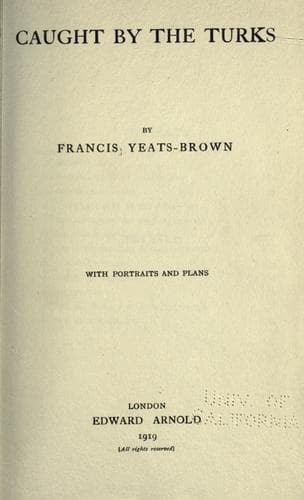
World War, 1914-1918 -- Prisoners and prisons, Turkish
But one could not smile for long in that little room, thinking of the
sun and air outside and the old 'bus lying wrecked in the desert. We
would have been flying back now; we would have reconnoitred the Turkish
lines; we would have been back by nine o'clock to breakfast, bath, and
glory. . . .
"It's the thirteenth of the month," groaned the pilot, whose thoughts
were similar to mine.
For a long time I sulked in silence, while the pilot, with better
manners or more vitality than I, engaged the gendarmes in light
conversation, conducted chiefly by gesture. About an hour later (a "day"
of the Creation, it seemed to me--and it was indeed a formative time,
when the mind, so long accustomed to range free, seeks to adjust its
processes to captivity and adapt itself to new conditions of time and
space) there occurred at last a diversion to interrupt my gloom.
The Turkish District Governor arrived with two carriages to take us to
Baghdad. He spoke English and was agreeable in a mild sort of way,
except for his unfortunate habit of asking questions which we could not
answer. He told us that news of our descent and capture had been sent to
Baghdad by gallopers (not by telegram, I noted parenthetically) and that
the population was awaiting our arrival. I said that I hoped the
population would not be disappointed, and he assured us with a
significant smile that they certainly would not.
"Whatever happens," he was kind enough to add, "I will be responsible
for your lives myself."
His meaning became apparent a little later, when we approached the
suburbs of Baghdad and found an ugly crowd awaiting our arrival, armed
with sticks and stones. When we reached the city itself the streets were
lined as if for a royal procession. Shops had put up their shutters, the
markets were closed, the streets were thronged, and every window held
its quota of heads. The word had gone out that there was to be a
demonstration, and the hysteria which lurks in every city in a time of
crisis found its fullest scope. Our downfall was taken as an omen of
British defeat, and the inhabitants of Baghdad held high holiday at the
sight of captive British airmen.
Public-domain text, read in full here on John Shaqi.
Reviews
Reviews
No reviews yet
Be the first to share your thoughts on this work.
Join the Discussion
Join the discussion
Sign in to leave a comment or review.
Sign InorCreate an account