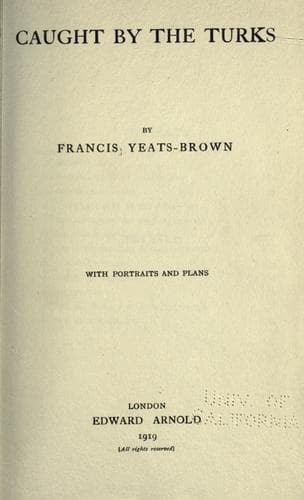
World War, 1914-1918 -- Prisoners and prisons, Turkish
There were lecturers (really good ones) who discoursed on a wide range
of topics, from Mendelism to Mesopotamia. There were professors of
French, Italian, Greek, Russian, Turkish, Arabic, Hindustani, and I
daresay all the languages of Babel, ready to teach in return for
reciprocal instruction in English. Our library contained many luminous
volumes, kindly sent out by the Board of Trade. Law and Seamanship,
Semaphoring and Theology, Carpentry and the Integral Calculus, Gardening
and Genetics--such is a random selection of the subjects on which there
were experts available and eager to impart information.
But, personally, my mind resisted the seductions of learning. I learned
only how to waste time. And sometimes, perhaps, I touched the hem of
Philosophy's garment, and stammered a few words to her. Otherwise I did
nothing except try to forget things . . . things seen.
Yet one enjoyed oneself, occasionally. The football was great fun. So
also were some of the lighter sides of our indoor life. Poker used to
pass the time. So also, though more rarely, did reading. The plays which
a dramatist--soon to be eminent, I expect--presented to enthusiastic
audiences are delightful memories. His revues and topical verses were
worthy of a wider audience, and I am sure his work--unlike the most of
our labours--will not be wasted.
But best of all, I think, was to sit in a circle on the floor round a
brazier on a winter's evening, and sip hot lemon _'araq_, and listen to
songs and stories. It was a relief to laugh, and forget the fate of
those we could not help.
"Sweet life, if love were stronger,
Earth clear of years that wrong her . . ."
sang a soft Irish voice, whose melody seemed to melt into the cold of
one's captivity. . . . Then there were the fancy dress balls held on New
Year's Eve in 1917 and 1918. So good were they that for the night one
completely forgot one's surroundings. A very attractive barmaid
dispensed refreshments behind a table. There were several debutantes,
and at least one chaperone. Pierrot was there, and Pierrette, and
Mephistopheles, and Bacchus, and a very realistic Pirate. If some
reveller in London had looked in on us at midnight he might easily have
fancied himself at an Albert Hall dance. He would certainly not have
guessed that all the clothes and furniture and food were home-made, and
that everyone in the room was a British officer. The self-confident
flapper, for instance, who could only have given him "the next missing
three" was a Major in the Flying Corps. And the girl at the bar, with
big brown eyes, who would have offered him _'araq_ so charmingly was
really a submarine officer of the Navy, and a well-known figure at "The
Goat."
After functions such as these, the morning after the night before found
me wondering where it would all end. If the war lasted another ten
years, would I ever be fit to take a place in normal life? How long
could I keep sane in this topsy-turvy world? . . .
* * * * *
Public-domain text, read in full here on John Shaqi.
Reviews
Reviews
No reviews yet
Be the first to share your thoughts on this work.
Join the Discussion
Join the discussion
Sign in to leave a comment or review.
Sign InorCreate an account