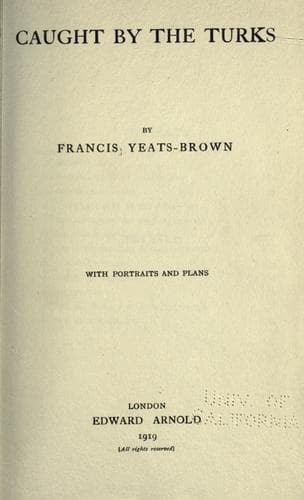
World War, 1914-1918 -- Prisoners and prisons, Turkish
Often, lying a-bed in the early morning, I used to feel that my body was
completely gone, and that only a fanciful and feverish intelligence
remained. I remember especially one dawn in the spring of 1917, when I
watched two figures passing down the station road. Slouching towards the
station, and all unconscious of the beauty of the waking world, came a
soldier with his pack and rifle. He wore the grey Turkish uniform, his
beard was grey, his cheeks were also grey and sunken. Slowly, slowly he
dragged his heavy feet towards the train that would take him away to the
war. The train had been already signalled, I knew (for I kept notes of
the traffic in those days), and I found myself hoping anxiously that he
would not be late. The sooner he was killed the better. He was old and
ugly and ill. If only such as he could perish. . . . Then my thought
took wings of the morning. From the soldier, plodding onwards devotedly,
as so many men have gone to their deaths, my eye ranged across the
plains, lying dim and dark to eastward, to the horizon mountains of the
Suleiman Dagh, whose snow had already seen the messengers of morning
hasting from the lands below our world. And man seemed mean and minute
in the purposes of Nature. So ugly was he, such a blot on the landscape
with his trains and soldiers, that I wondered he continued to exist.
There was a life above our life in the dawn. The powers of the world
knew nothing of this soldier's hopes and fears. To them his endeavours
were a comedy. A huge mountain-back, with the gesture of some giant in
the playtime of long ago, seemed shrugging its shoulders at this
ridiculous straying atom of a moment's space. The train came in, and I
saw its smoke above the tree-tops of the station. It whistled shrilly,
and the soldier quickened his pace. No doubt he was late. Perhaps he
still survives, and is toiling even now towards some trench. Anyway he
passed from my ken, but I still stood at the window, looking towards the
mountains and the sky.
Then there passed an archaic ox-cart, creaking down the road slowly, as
it has creaked down the ages, from the night of Time. It was drawn by a
white heifer, whose shoulders strained against the yoke, for it was a
heavy cart. But she went forward willingly, resignedly. Work was her
portion. She would live and die under the yoke. She licked her cool
muzzle, dusted flies with her neat tail, and looked forward with
wistful eyes that seemed to see beyond her working world, to some
ultimate haven for the quiet workers. Somewhere she would find rest at
last. To my feverish imagination that white heifer symbolised the pathos
of all the driven souls who go forward unquestioning to destiny.
And the soldier with his pack was a type also of voiceless millions who
carry the burden of our civilisation.
Public-domain text, read in full here on John Shaqi.
Reviews
Reviews
No reviews yet
Be the first to share your thoughts on this work.
Join the Discussion
Join the discussion
Sign in to leave a comment or review.
Sign InorCreate an account